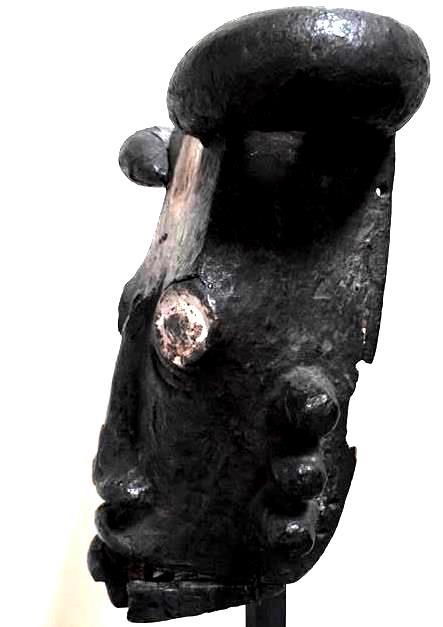
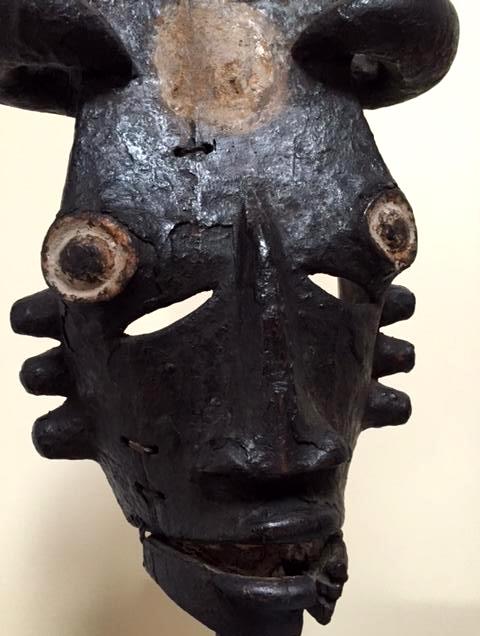
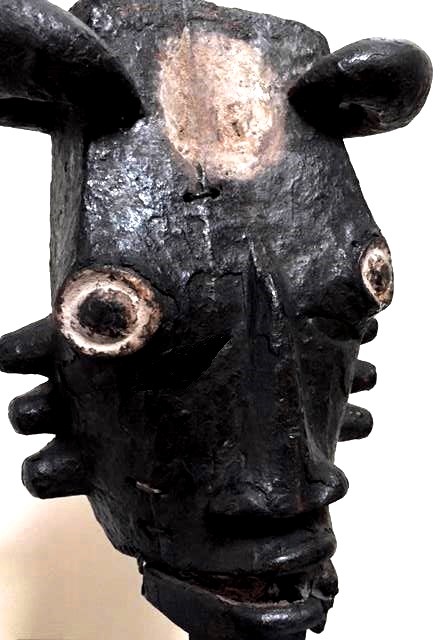
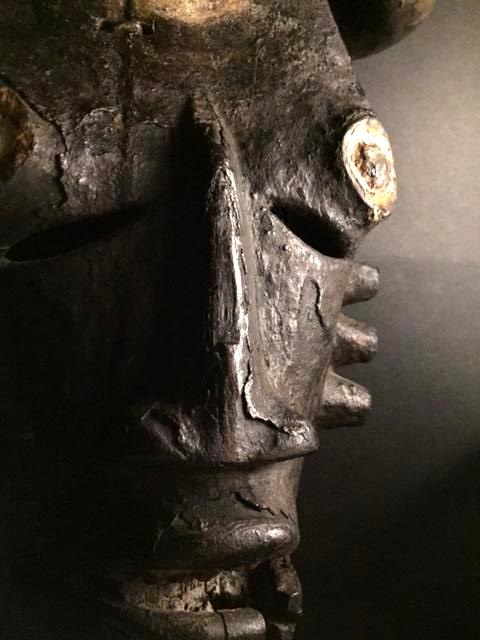
Le lacrime del Kota

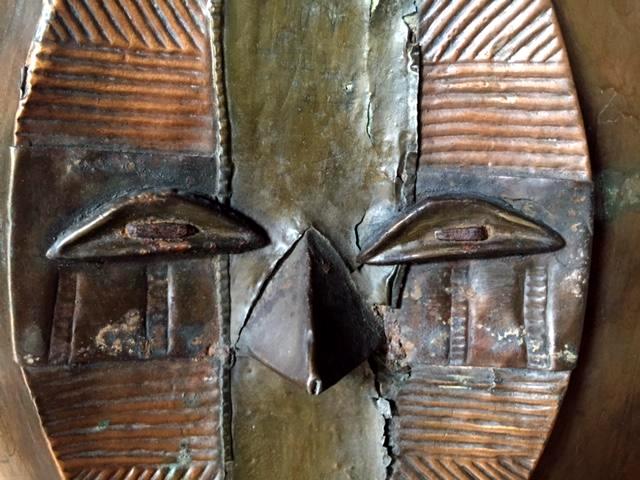
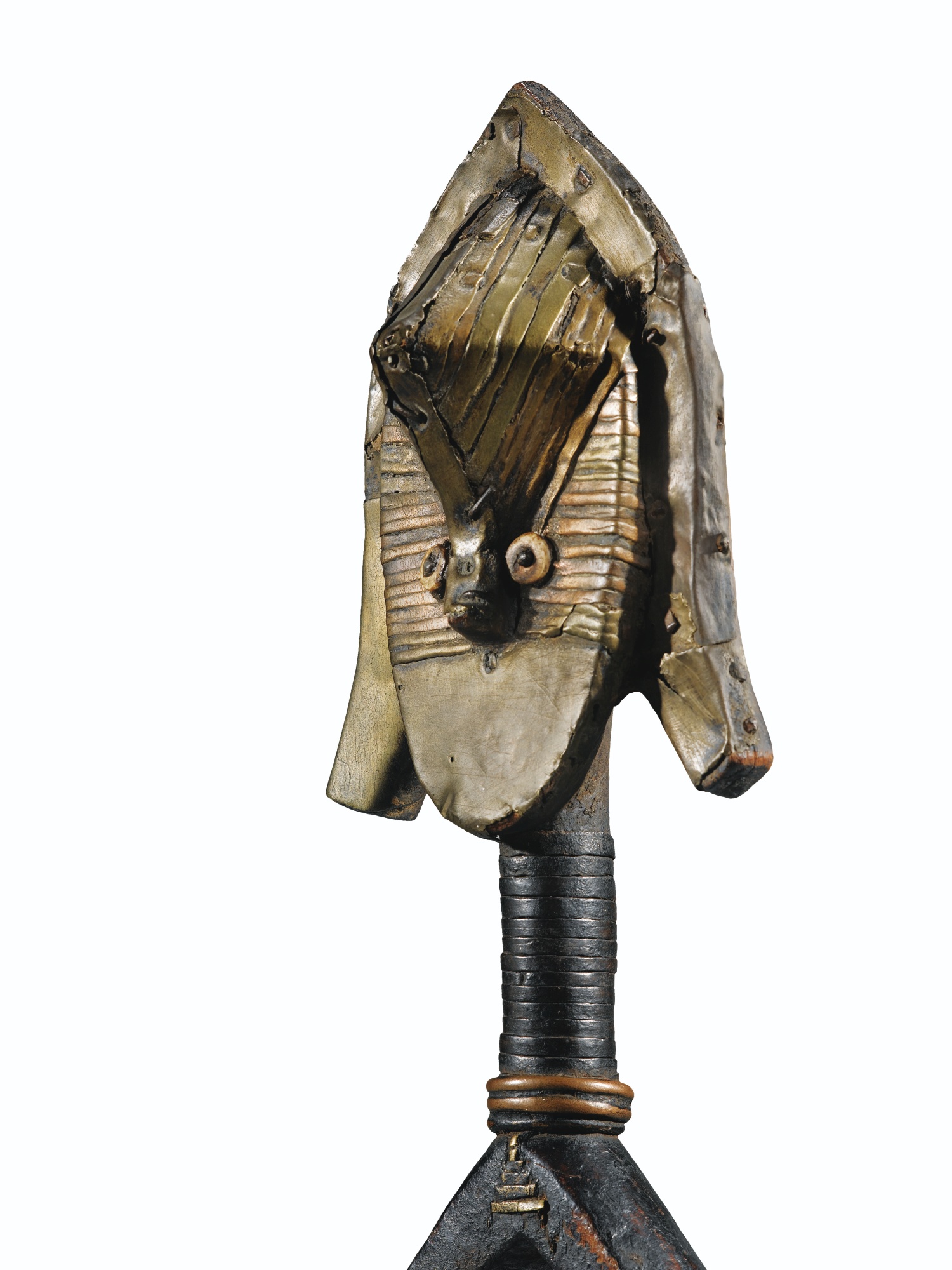
Quelle “lacrime” che si vedono su alcuni reliquiari Kota, specie su quelli provenienti dalle terre Kota più meridionali, come quelli Obamba o Ndassa… cioè quelli più afferenti all’area culturale Teke, meritano un ulteriore approfondimento ( v. https://artidellemaninere.com/2015/08/10/testa-e-croce-nelle-cultura-funeraria-kota/).
Dopo il confronto con appassionati della cultura Kota, due, in sostanza, rimangono le interpretazioni possibili.
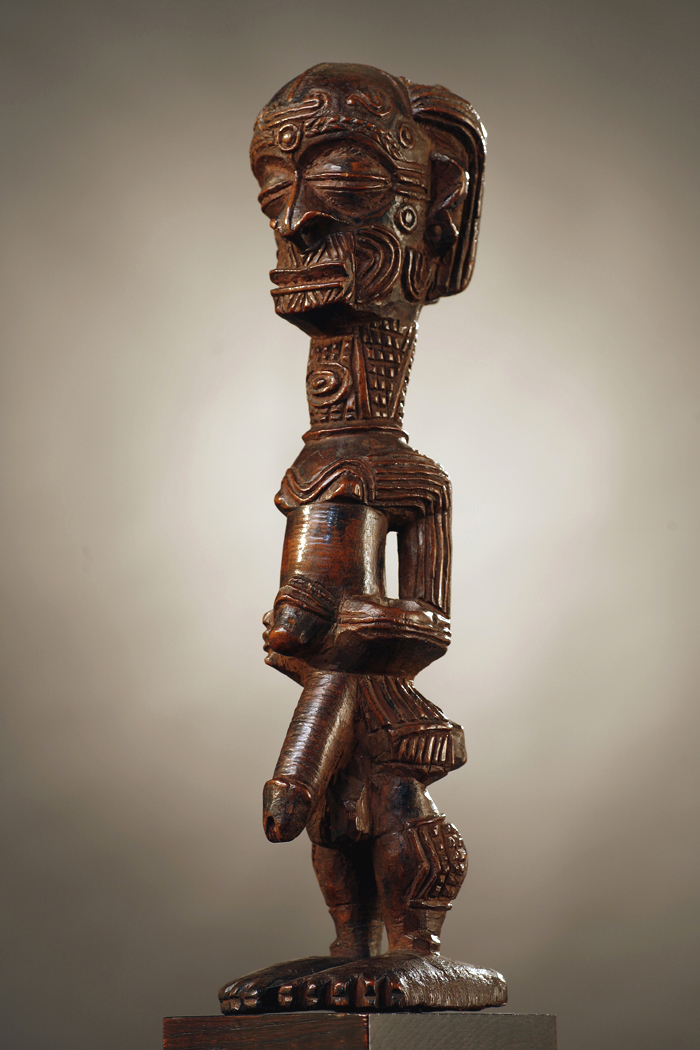
La prima è quella che considera le “lacrime” delle scarificazioni facciali, tali e quali a quelle sui volti delle figure della cultura Teke.

teke_t10

La seconda interpretazione è che questi segni sotto gli occhi del reliquiario, invece, siano in un certo senso riferibili all’iconografia cristiana, come ho scritto nell’articolo citato dove scrivevo che ovviamente tutto questo non significa affatto l’attribuzione di un sia pur recondito significato religioso cattolico ai Kota; niente di tutto ciò se non l’innato sincretismo della creatività dei popoli africani che spesso hanno tradotto in forme artistiche autoctone gli stimoli provenienti da altre culture che evidentemente avevano colpito la loro fantasia ed immaginazione.

Il confronto ha però fatto emergere una terza possibile interpretazione.

Quei segni sono si riferibili alle lacrime, ma la cultura che li ha generati rimane quella tribale.

Volto6

Vale a dire, questi Kota con le lacrime sarebbero in realtà non soltanto i reliquiari custodi delle ossa degli antenati, ma anche figure investite di significati secondari, e nello specifico, del significato di scrutare il mondo dell’invisibile.

Sono note alcune pratiche rituali riservate ad iniziati che facevano ricorso a polveri e sostanze urticanti che provocavano inevitabilmente al contatto del viso la lacrimazione degli occhi. Attraverso la pratica magica del rito, però, l’iniziato stesso era in condizione di accedere al mondo dell’ invisibile, a quello degli spiriti.

Questa tipologia di raro reliquiario, di conseguenza, come ha acutamente sottolineato un amico specialista di quest’area, costituirebbe una figura le cui caratteristiche sarebbero quelle di the Kota would then insist on its ability to see the unseen world.

Come ognuno può notare, è intricato quanto affascinante l’approfondimento di queste tematiche, il cui svelamento non può procedere che per ipotesi, confronti e deduzioni …misteriosi al dunque, quanto gli occhi sbircianti del Kota.

Elio Revera

Volto5

English version

Tears of Kota

The reference to the “tears” that you see on some Kota reliquaries, especially those most southern Obamba, Ndassa … that is the most related to the cultural Teke, deserves attention (v. https://artidellemaninere.com/2015/08/10/testa-e-croce-nelle-cultura-funeraria-kota/).
In light of interesting comparisons with qualified specialists of culture Kota, there are two possible interpretations.
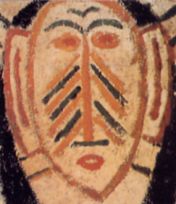
The first is what he considers the “tears” of facial scarification, such as those found on the faces and figures of culture Teke.

testa con scarificature 1907
P. Picasso, Testa con scarificazioni, 1907

The second interpretation is that these signs before the eyes of the reliquary is in a sense related to Christian iconography, as I have shown in the work related to this. Obviously this does not mean the assignment of an albeit hidden religious meaning to the Catholic Kota; none of this if not the syncretism of the innate creativity of the African peoples who have often translated into art forms indigenous knowledge from other cultures who had obviously hit their creativity and imagination.

The comparison, however, has revealed a third possible interpretation.
Those signs are tears, but the culture that created them is tribal.

Namely, these Kota tears would actually not only the reliquaries that hold the bones of the ancestors, but also the figures invested with meaning “secondary”, and specifically, the meaning to scrutinize the invisible world.
Known ritual practices were reserved for initiates who use substances stinging, which generated inevitably eye tearing, but that allowed the initiate himself to penetrate the world of the ‘invisible, that of spirits.
This type of rare reliquary, consequently, would figure that a dear friend, who now intends to remain anonymous, considers ” the kota would then insist on its ability to see the unseen world”.

As anyone can see, intricate and fascinating is the deepening of these issues whose disclosure may not proceed to that hypothesis, comparisons and deductions … mysterious as the searching eyes of Kota.

Elio Revera

Territorio
Gabon, 1884

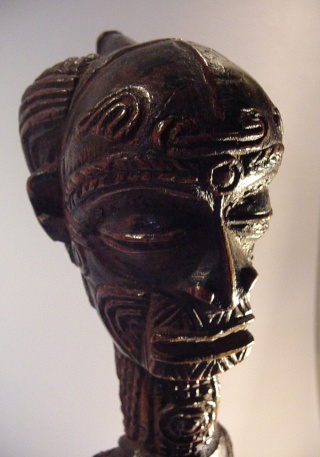
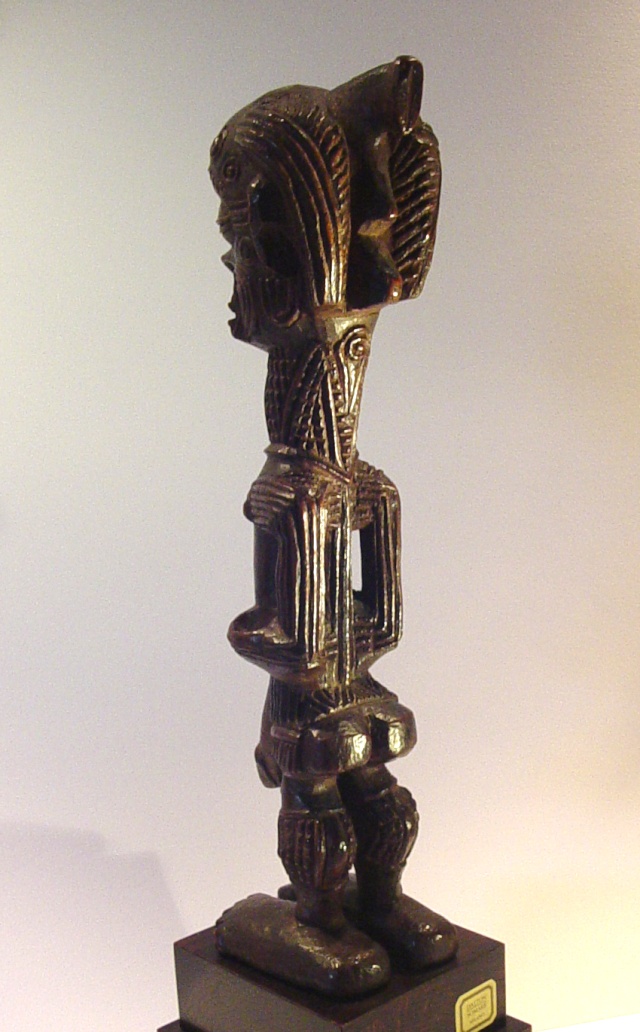
Luluwa people, male priapic figure, mukendi o mukenge, Southern Kasaï/Sankuru Region, Demba Area, Rep. Dem. Congo.

Bena Luluwa

Wood, dust wood and reddish earth
H. 11,4in/29cm

Private collection Italy,
Photo Courtesy Pietro Paletti
Arti delle Mani Nere All Rights Reserved


Provenance

-Karel Timmermans coll. – Bruxelles
-Thomas Alexander coll. – Saint Louis
-Martin Lerner coll. – New York
-Patrick Caput coll. – Parigi
-Pace Primitive – New York

Exhibitions

-Parcours des Mondes, Parigi, 2003
-Scultura. Arte dell’Africa , Gall. Dalton Somaré, Milano, 2009
-L’Africa delle Meraviglie. Arti Africane nelle collezioni italiane. Museo Palazzo Ducale, Genova, December 2010 – 5th June 2011

Published
-Pace Primitive Gallery, Parcours des Mondes, 2003, fig. 32 color
-Scultura. Arte dell’Africa, Milano, Galleria Dalton Somaré, 2009, pag.79, 80 color
-Qui Brescia, anno 7, n. 65, December 2010, Brescia, pag. 142, color
-Bargna I, e Parodi da Passano G., L’Africa delle meraviglie – Arti africane nelle collezioni italiane, Genova, 2010, Silvana Editoriale, Cinisello Balsamo (MI), pag. 195, color

The Bena Luluwa are allocated along the lower reaches of the Lula River, and after the group people collectively called Kuba, they represent the second largest stylistic group of Kasai-Sankuru.

Clearly distinct from that of its neighbors Bashilele, Binji, their style is based on a static sculpture, a net volume, which tends to convey an impression of haughty dignity and energy, enriched in a systematic manner by elaborately carved decorations.

dsc00915

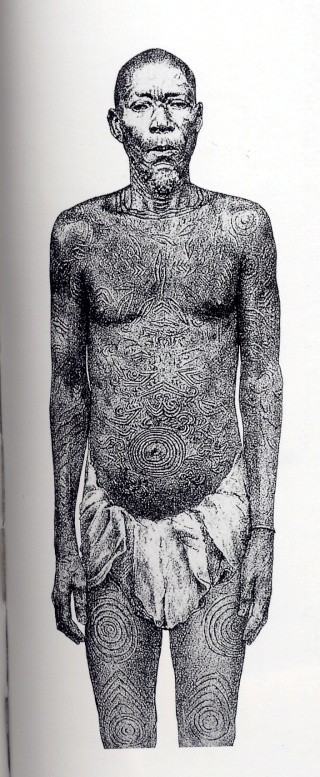
This ornate isn’t a mere ornament and reproduces the signs impressed on the body of the dignitaries and heads (tshilenge tshilu) and is a key element in the establishment of the authority figure.

chief_12
Chef Luluwa.” Signes du corps”, 2004, (Baluba man with tattoos. 1898. W. Dreyer)

The male figures Luluwa are considerated to be effigies of founders leaders of the lineage. The power and authority of the person represented in this sculpture, are well made by the expression of the face, the careful hair from the trunk leaning forward, the big navel and penis and by all the tattoos/signs on his face and all body.
Complete the sculpture, big feet that guaranteed its stability during continuous treatment to which he was being subjected.

K. Timmermans who gathered in situ sculpture, reports that it is a work in the sub-group called Bena Makuna.

The nature of the sculpture, which P. Caput called “assez rare”, is still recognized in the iconography of Bena Luluwa and in fact such was published by Himmelheber, alongside other statues from the traditional.

luluwa11
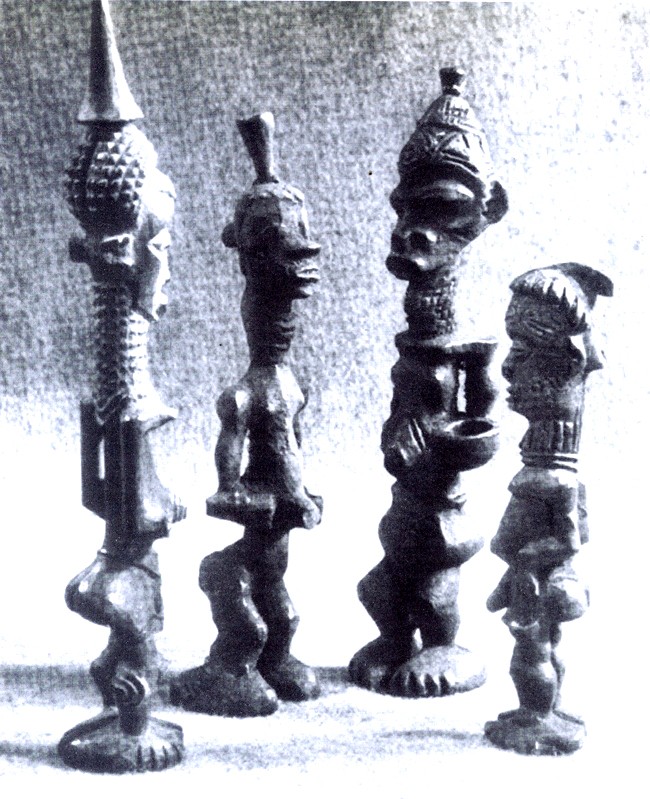
H. Himmelheber “Negerkunst und Negerkunstler” (1960)

In reference to the type of this sculpture, M. Felix has written ” En ce qui concerne la puissante figurine du grand monde Bena Lulua raprésentant un mâle priapique, nous écartons du grand classicisme Lulua puisque nous y sentons déjà une forte influence des Luba du Kasaï, notamment dans la coiffure et l’expression de la bouche, ainsi que dans l’angularité des chéloïdes. Mais néanmoins, je trouve l’ensemble fort réussi.”

Bibliograhy

-Samain A., “Geschiedenis der Bena Lulua”, Congo, Congo, 1922, 3, II, 229-232
-De Clercq A., “Le chanvre chez les Bena Lulua.” Congo, 1928, I, 504-514
-Kalanda Mabika A., “Baluba et Lulua. Une ethnie à la recherche d’un nouvel équilibre” Bruxelles, 1959
-Noul L., “Le mbulenga”, Musées de Genève, 1960, 8, sept., 2-3
-Himmelheber H., “Negerkunst und Negerkunstler”, Klinkhardt & Bierman, Braunschweig, 1960, 394-395, # 318
-Timmermans P., “Essai de typologie de la sculpture des Bena Luluwa,“, Africa- Tervuren, 1966, XII,, 1, 17-27
-Neyt F., “Arts traditionells et histoire au Zaire”, Université Catholique de Louvain, Louvain, 1981
-Maesen A., “Statuaire et culte de fécondité chez les Luluwa du Kasai ( Zaire)”, Milano, 1982, in Quaderni Poro, n.3, Atti del Convegno di Venezia, giugno/luglio 1981, 49-58
-Baya T. K., “À propos de la conception du rêve en milieu traditionnel Lulua”, in Cahiers de sociologie économique et culturelle, 1985, no 4, p. 165-176
-Petridis C, “Luluwa masks” , in African Arts (Los Angeles), 1999, vol. 32, no 3, p. 91-94
-Petridis C., “Art and Power in the Central African Savanna: Luba. Songye. Chokwe. Luluwa” 2008, MercatorFonds, Belgium

Yale University
N. 0000701-01

ppp


Luluwa people, male priapic figure, mukendi o mukenge, Southern Kasaï/Sankuru Region, Demba Area, Rep. Democratica Congo.

H.cm.29
Legno, polvere rossastra di legno e terra

Collezione privata, Italia
Arti delle Mani Nere All Rights Reserved
Foto Courtesy Pietro Paletti

Provenienza
-Coll. Karel Timmermans – Bruxelles
-Thomas Alexander coll – Saint Louis
-Coll. Martin Lerner – New York
-Coll. Patrick Caput – Parigi
-Pace Primitive – New York

Esposizioni
-Parcours des Mondes, Parigi, 2003
-Scultura. Arte dell’Africa , Gall. Dalton Somaré, Milano, 2009
-L’Africa delle Meraviglie. Arti Africane nelle collezioni italiane. Museo Palazzo Ducale, Genova, 30 dicembre 2010-5 giugno 2011.


Pubblicazioni

-Pace Primitive Gallery, Parcours des Mondes, 2003, fig. 32 color
-Scultura. Arte dell’Africa, Milano, Galleria Dalton Somaré, 2009, pag.79, 80 color
-Rivista Qui Brescia, anno 7, n. 65, dicembre 2010, Brescia, pag. 142, color
-Bargna I, e Parodi da Passano G., L’Africa delle meraviglie – Arti africane nelle collezioni italiane, Genova, 2010, Silvana Editoriale, Cinisello Balsamo (MI), pag. 195, color

I Bena Luluwa stanziati lungo il corso inferiore del Lula River, rappresentano dopo l’insieme di popolazioni collettivamente denominato Kuba, il secondo maggior gruppo stilistico della Regione del Kasaï -Sankuru.

Nettamente distinto da quello dei vicini Bashilele, Binji, il loro stile si fonda su una scultura statica, a volumi netti, che tende a trasmettere un’impressione di altera dignità ed energia, arricchita in modo sistematico da decorazioni minuziosamente intagliate.

Questo ornato che non è affatto mera illustrazione, riproduce al contrario i segni impressi sul corpo dei dignitari e dei capi ( tshilenge tshilu) ed è un elemento fondamentale nella costituzione dell’autorità della figura.

Le figure maschili Luluwa si considera siano effigi dei capi fondatori del lignaggio. La potenza e l’autorevolezza del personaggio rappresentate in questa scultura, sono ben rese dall’espressione fiera e composta del volto, dall’accurata capigliatura, dal tronco proteso in avanti, dai grandi ombelico e pene e dall’insieme dei fini tatuaggi/scarificazioni sul viso e su tutto il corpo. Completano la scultura, gli imponenti piedi che garantivano la sua stabilità nel corso delle continue cure a cui era fatta oggetto.

p

K. Timmermans che ha raccolto “in situ” la scultura, riferisce che essa è un’ opera nell’ambito del sotto/gruppo etnico denominato Bena Makuna.

La tipologia di questa scultura, che P. Caput ha considerato “assez rare”, è comunque riconosciuta nell’iconografia dei Bena Luluwa ed infatti una simile è stata pubblicata da Himmelheber, accanto ad altre statuette dall’iconografia tradizionale.

M. Felix, proprio in riferimento alla tipologia di questa scultura ha scritto ” En ce qui concerne la puissante figurine du grand monde Bena Lulua raprésentant un mâle priapique, nous écartons du grand classicisme Lulua puisque nous y sentons déjà une forte influence des Luba du Kasaï, notamment dans la coiffure et l’expression de la bouche, ainsi que dans l’angularité des chéloïdes.
Mais néanmoins, je trouve l’ensemble fort réussi.”

dsc00917

Teke people, Consecrated Magical Figure, Republic of the Congo

Teke 1 cattabiani

End of 19th century
H 14 in/ cm.35,5 wood, sacrificial matter (bonga), color

Private collection, Italy
Photo by Fabio Cattabiani
Arti delle Mani Nere All Rights Reserved

Provenence

L. Van de Velde coll. Antwerp
J. Blanckaert coll. Bruxelles
F. Réveillaud Nast, Parigi

Published

-R. Berry et al: A private collection of primitive art. Chicago, Figure # 20, 1971
-Linda Sigel, A private collection at the Art Institute of Chicago, in African Arts, Autumn 1971
Vol. 05, 1, pag.51.
-Bargna I, e Parodi da Passano G., L’Africa delle meraviglie. Arti africane nelle collezioni italiane, Genova, 2010, Silvana Editoriale, Cinisello Balsamo (MI), pag. 121, color
-Carini V., Martinis L. L’Africa di Attilio Pecile. Gli oggetti di un itinerario, Paolo Gaspari Ediore, Udine, pag.48, color.

Exhibition

-A private collection of primitive art, Art Institute of Chicago, Chicago, 1971
-Aaoarts Gallery, Parigi, 1998
-Parcours des mondes, Parigi, 2007
-L’Africa delle meraviglie – Arti africane nelle collezioni italiane, Palazzo Ducale e Castello d’Albertis, 31th December 2010 –5th June 2011.
-L’Africa di Attilio Pecile attraverso i resoconti della missione scientifica Brazzà-Pecile al seguito di Pietro Savorgnan di Brazzà (1883-1886), Palazzo Municipale, Fagagna ( Udine), 31 March/16 September 2012

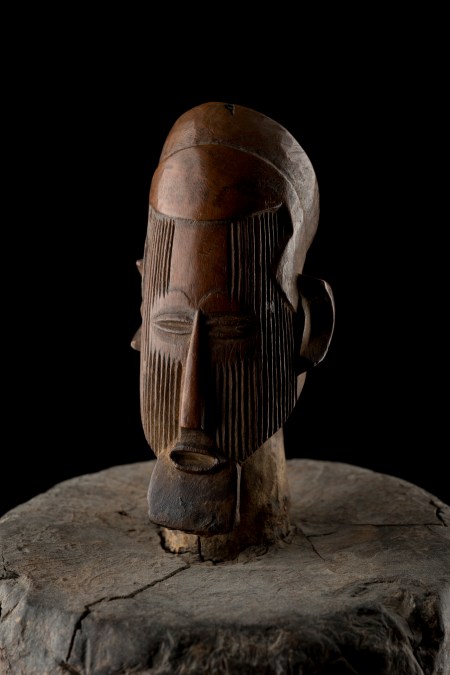
”The bearded Teke fetish with typical striated scarification patterns has a sculptural quality.This is, however, of secondary importance.

Teke Viso frontale cattabiani

The medicinal ingredients included give ‘value’ to these charms, which are produced in grest number by these people from Congo Brazzaville. The fetish is first carved with a square cavity, which is later filled with special ingredients prescribed by a religious specialist, who sometimes includes a piece of his beard with the mixture. A layer of resin containing more magical substances is added and reddish tukula is rubbed into the wood to secure the power of the charm. Denise Paulme suggests that these figures are kept by children for security ( see Les Sculptures de l’Afrique Noire). At birth, a piece of the placenta of the newborn is mixed with tukula and placed in the hollow.

The child then carries the figure until adolescence, when it is discarded. As Teke fetishes are quite common, it is rare to find one as finely carved as this example “(Linda Sigel)

“Their magical statuettes (generally called biteki or bitegué), almost always representative of a male, cannot be precisely catalogued, as only the recipient and their sculptors knew their intrinsic powers and the use for which they had been intended. According to R. Lehuard (1996), the bifwa statuettes, related to ancestor worship, are of two types: bankaga, representative of positive spirits, and mupfu, representative of negative spirits, which were in turn divided into nkiba (statuettes without relics or additions of any kind), and buti (butti). These more important statuettes, abundant with relics which materialized the spirit and supernatural power, were physical depictions of the ancestors. These statuettes could possess: bonga, a category of powers which comprised therapeutic components, nsala, for healing powers, iloo, with powers to fight against witchcraft, sorceries and the evil spirits of the ancestors, or ikwene, with magical forces of protection that ensured success in any undertaking.

teke testa profilo cattabiani

According to the historian Jan Vansina, author of a monograph/dissertation on the Teke-Tio following field research from 1963 to 1965, the statuettes were called magic itio (a wooden figure used as a fetish.)”
(Courtesy Vittorio Carini, Artes Africanae)

Bibliography

-R. Berry et al, A private collection of primitive art, Art Institute of Chicago, Chicago, 1971
-Linda Sigel, A private collection at the Art Institute of Chicago, in African Arts, Autumn 1971
-Lehuard Raoul: Statuaire du Stanley-Pool, Villiers-le-Bel, Arts d’Afrique Noire, 1974.
-Lehuard Raoul: Les Arts Bateké, Arnouville, Arts d’Afrique Noir, 1996.
-Obenga Théophile: Le peuple teke en Afrique Centrale, Libreville, Muntu n. 7, 1987.
-Vansina Jan: Les noms personels et la structure sociale chez le Tio (Teké), Bullettin d’Outre-Mer,1964

Yale University Art Gallery, n. 0003678-01.

teke0511
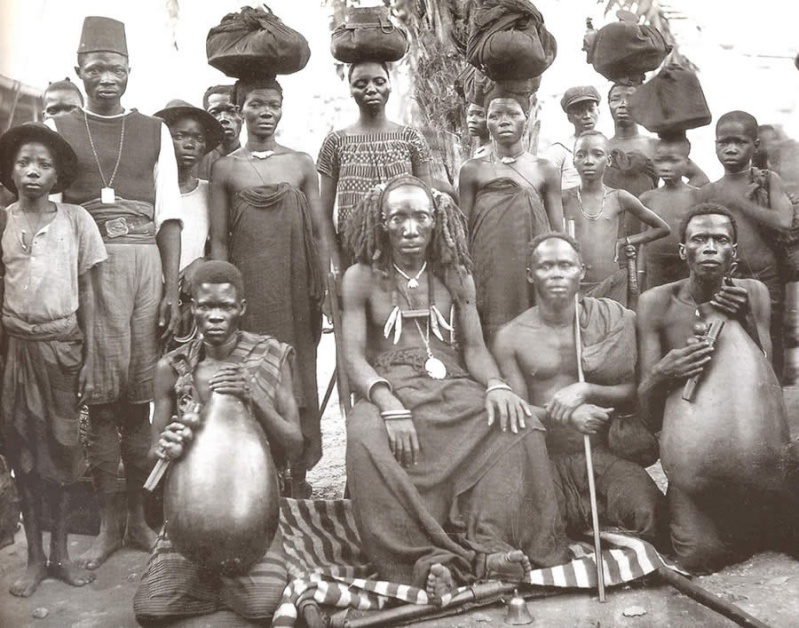
Teke Chief, late 1800s. From: Raoul Lehuard, Les Arts Bateké, 1996, Courtesy A.A.N. (Documentation Pierre Dartevelle.)


Teke, figura magica consacrata, Rep. del Congo

H cm.35,5 legno, materia terrosa (bonga), pigmenti colore.

Collezione Privata, Italia
Foto Fabio Cattabiani
Arti delle Mani Nere All Rights Reserved

Provenienza
Coll. L.Van de Velde – Antwerp
Coll. J. Blanckaert- Bruxelles
F. Réveillaud Nast-Parigi

Esposizioni
-A private collection of primitive art, Art Institute of Chicago, Chicago, 1971
-Aaoarts Gallery, Parigi, 1998
-Parcours des mondes, Parigi, 2007
-L’Africa delle Meraviglie. Arti Africane nelle collezioni italiane. Museo Palazzo Ducale, Genova, 30 dicembre 2010-5 giugno 2011, color
-L’Africa di Attilio Pecile attraverso i resoconti della missione scientifica Brazzà-Pecile al seguito di Pietro Savorgnan di Brazzà (1883-1886), Palazzo Municipale, Fagagna ( Udine), 31 March/16 September 2012

Pubblicazioni
-R. Berry et al : A private collection of primitive art. Chicago, Figure # 20, 1971
-Linda Sigel, A private collection at the Art Institute of Chicago, in African Arts, Autumn 1971
Vol. 05, 1, pag.51.
-Bargna I, e Parodi da Passano G., L’Africa delle meraviglie. Arti africane nelle collezioni italiane,Genova, 2010, Silvana Editoriale, Cinisello Balsamo (MI), pag. 121
-Carini V., Martinis L.” L’Africa di Attilio Pecile. Gli oggetti di un itinerario”, Paolo Gaspari Ediore, Udine, pag.48, color.

“Questo feticcio barbuto con le classiche scarificazioni striate è una scultura di qualità. Ciò tuttavia è di secondaria importanza. Quel che dà valore a questo oggetti magico Teke del Congo Brazzaville sono i componenti medicinali che esso contiene.
Il feticcio è prima scolpito con una cavità quadrata, che viene successivamente riempita con ingredienti speciali che include a volte un pezzo della sua barba con la miscela, ingredienti prescritti dal divinatore investito di funzioni magico/religiose. Uno strato di resina che contiene più sostanze magiche è aggiunto e polvere di tukula rossastra è strofinata sul legno per assicurare il potere magico.
Denise Paulme suggerisce che queste figure magiche sono a protezione dei bambini (vedi Les Sculptures de l’Afrique Noire). Alla nascita, un pezzo di placenta del neonato è mescolato con tukula e collocato nella cavità. La figura segue il bambino fino all’adolescenza quando viene rimossa la carica magica.
I feticci Teke sono abbastanza comuni, è raro però trovare uno finemente scolpito come questo “(‘Linda Sigel, 1971)

teke_d10
Danza rituale dopo l’iniziazione.

“Le statuette magiche Teke (chiamate generalmente tutte biteki o bitegué), quasi sempre di tipo maschile, sfuggono anche a catalogazioni precise, poiché solo il destinatario e chi le fabbricava ne potevano conoscere i poteri intrinseci e l’uso al quale erano destinate.
Secondo R. Lehuard (1996), le statuette bifwa, legate al culto degli antenati, sono di due tipi: le bankaga, positive, e le mupfu, negative, a loro volta suddivise in nkiba (statuette senza reliquie e aggiunte di sorta) che rappresentavano fisicamente l’antenato, e buti (butti), statuette più importanti cariche di reliquie che ne materializzavano lo spirito e il potere soprannaturale. Queste statuette potevano detenere: i bonga, categoria che comprendeva componenti terapeutiche, le nsala, forze per ottenere la guarigione, le iloo, forze destinate a combattere contro i malefici, le stregonerie e contro gli spiriti degli antenati malvagi, oppure le ikwene, forze magiche di protezione che assicuravano il successo in ogni impresa.
Secondo lo storico Jan Vansina, autore di una monografia sui Teke-Tio in seguito a ricerche sul terreno dal 1963 al 1965, le statuette magiche erano chiamate itio (figura di legno utilizzata come feticcio.)”
(Vittorio Carini-Artes Africanae)

Bibliografia
-R. Berry et al: A private collection of primitive art, Art Institute of Chicago, Chicago, 1971
-Linda Sigel: A private collection at the Art Institute of Chicago, in African Arts, Autumn 1971
-Lehuard Raoul: Statuaire du Stanley-Pool, Villiers-le-Bel, Arts d’Afrique Noire, 1974.
-Lehuard Raoul: Les Arts Bateké, Arnouville, Arts d’Afrique Noir, 1996.
-Obenga Théophile: Le peuple teke en Afrique Centrale, Libreville, Muntu n. 7, 1987.
-Vansina Jan: Les noms personels et la structure sociale chez le Tio (Teké), Bullettin d’Outre-Mer,1964
Opera registrata alla Yale University Art Gallery, n.di archivio 0003678-01.

A cura di Elio Revera

teke testa dall'alto cattabiani

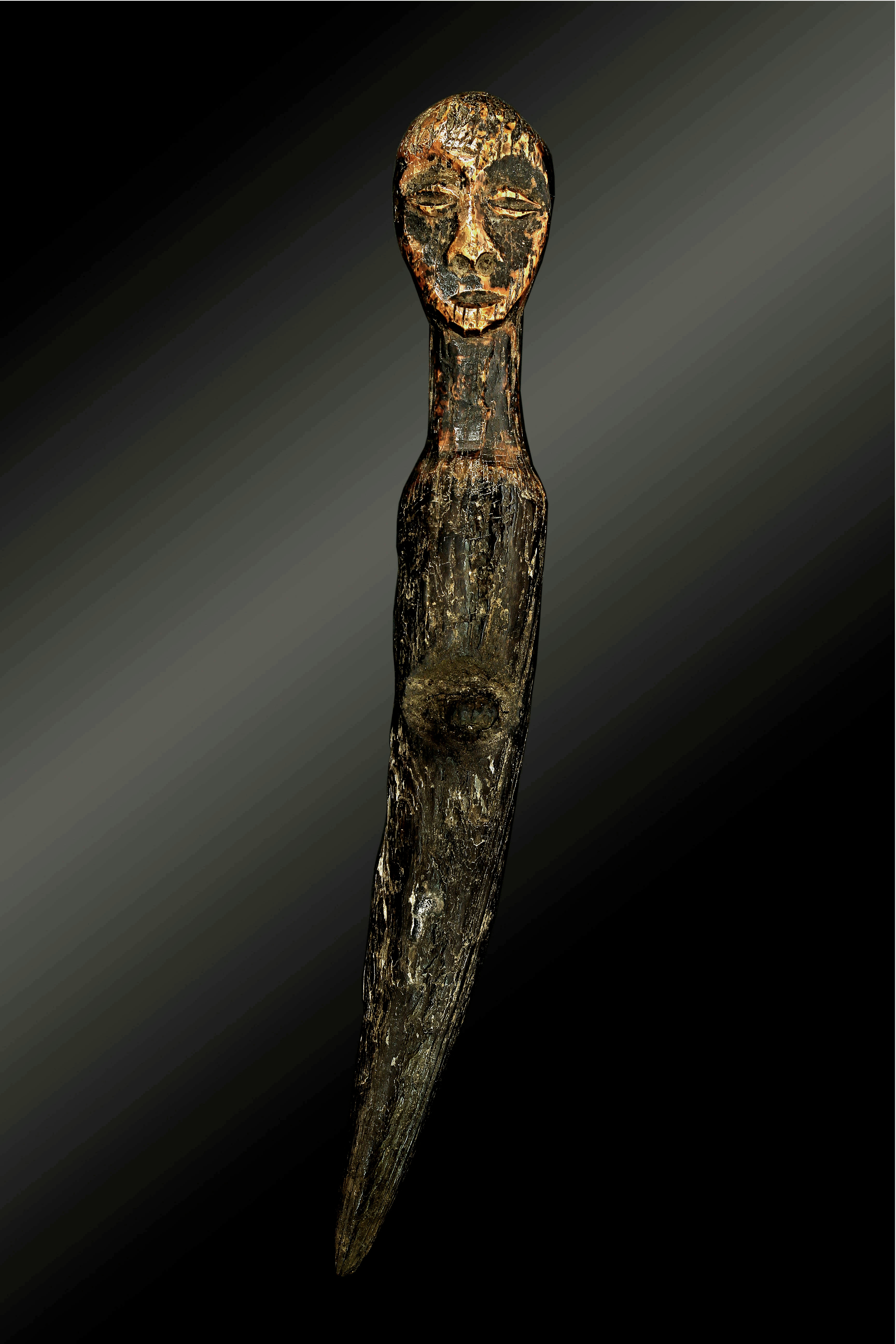
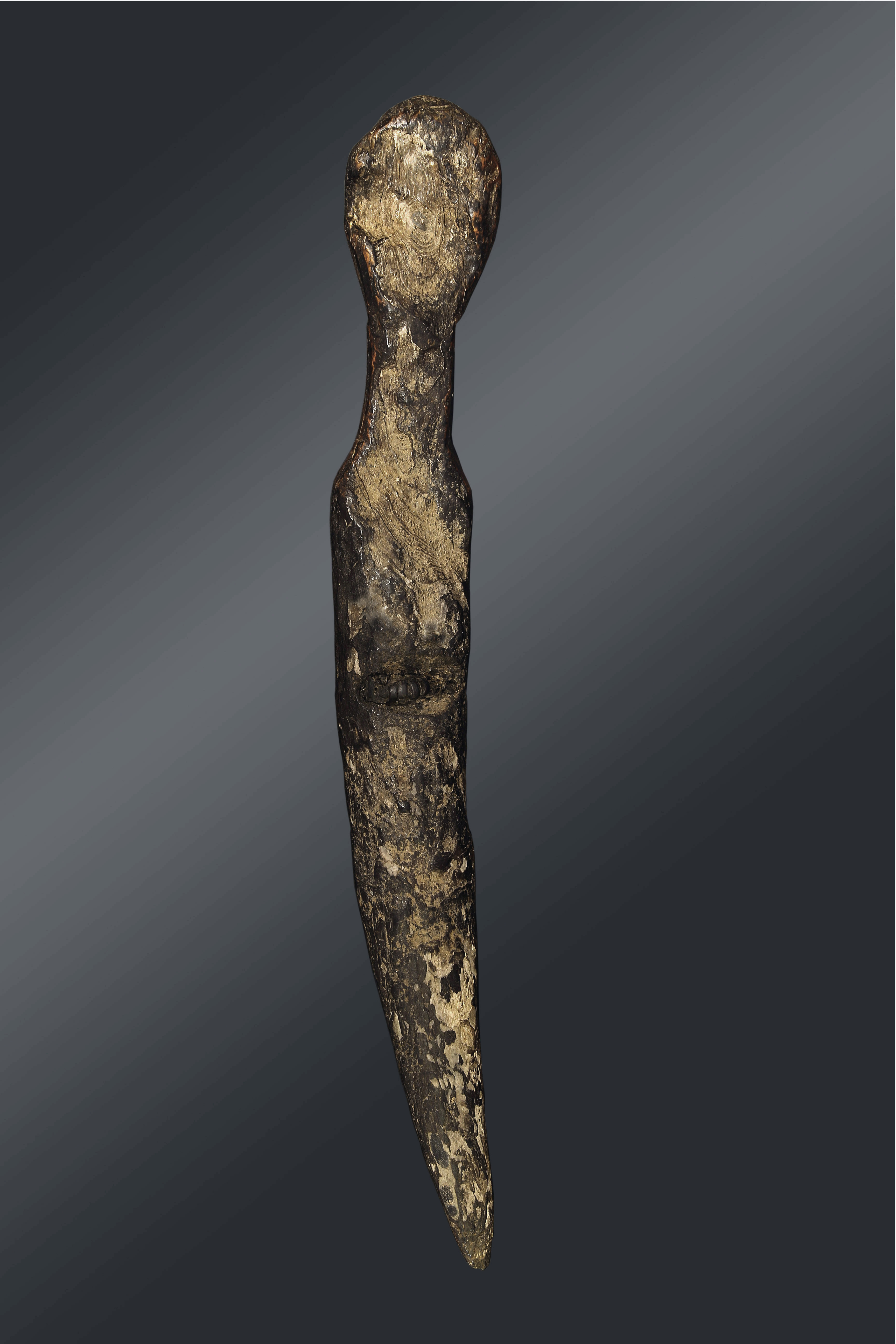
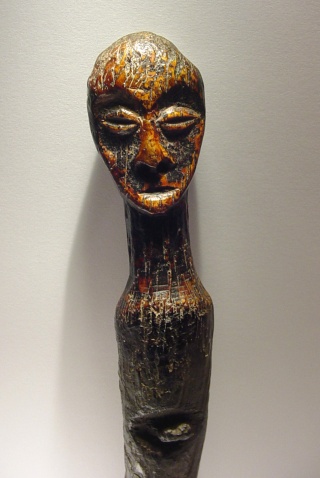
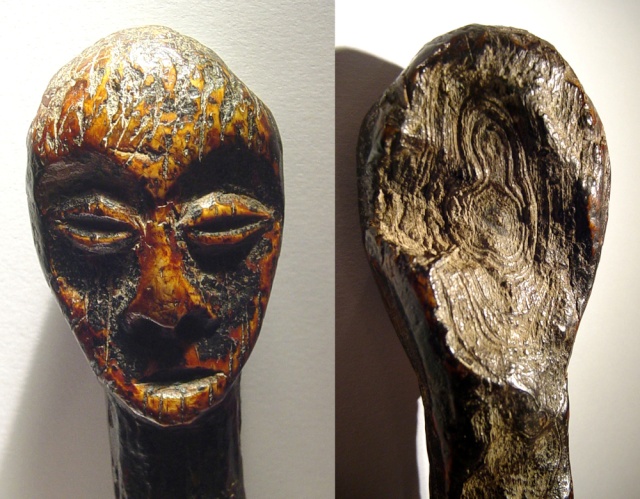
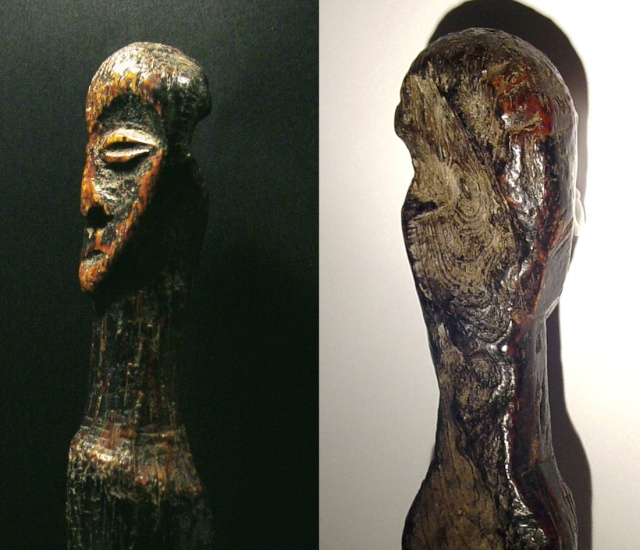
Lega people, Mokolo (Mukulu) figure, Shabunda Région, Kivu, Congo

Lega Mokolo figure (2)

Ivoire, patine d’usage, substance magique
H. cm. 29/11,43 inc.
XIXème

Provenance

-Mwami Ya Kindi Ngengele coll., Tusisi, Geo code: latit. -3,0833333 / longit. 27,2, Shabunda zone, Sud Kivu, Congo

-Coll. privée, Italie

bwami_12
Mwami Ya Kindi Ngengele et sa Kanyamwa

Publications

Marc Leo Felix “ White gold, black hands. Ivory sculpture in Congo”
Vol VI, Edited by Marc Leo Felix, Brussels, Belgium, 2013, pag. 38, fig. A114, color.

Cet objet a appartenu au vieux Mwami Ya Kindi Ngengele de Tusisi et son opinion il est qu’il est le plus ancien Mokolo de la zone de Shabunda et il précède l’arrivée des Belges.

Lega Mokolo figure retro

Cet objet nommé en effet, Mokolo Lwa Kindi, était enfoncé dans le sol où ils se déroulaient importantes cérémonies et il servait pour éloigner les esprits méchants et les sorciers.

Sur le corps du Mokolo il est présent la substance magique.

lega_m12

Le Mokolo du Musée Tervuren, avec la substance magique (cm 19), numéro d’inventaire EO.1974.21.18

mokolo10
Courtesy, Musée Royal de l’Afrique Centrale, Tervuren, Belgique.

Une autre interprétation de cet objet:

Pegs made of elephant bone represent the elephant’s ribs, and they also remind the viewer of the multiple meanings that Bwami assigns to the elephant. The image of the dead elephant, decomposed so that its ribs are expose, is evoked in the saying “Where elephant rots, there are many ribs”.
The saying , combined with the pegs, refers to the material possessions of a high-level Bwami member that are distributed at death. ( Biebuyck, 1986, 191)

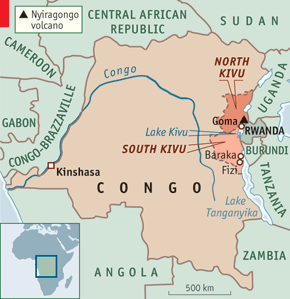
20110212_mam931
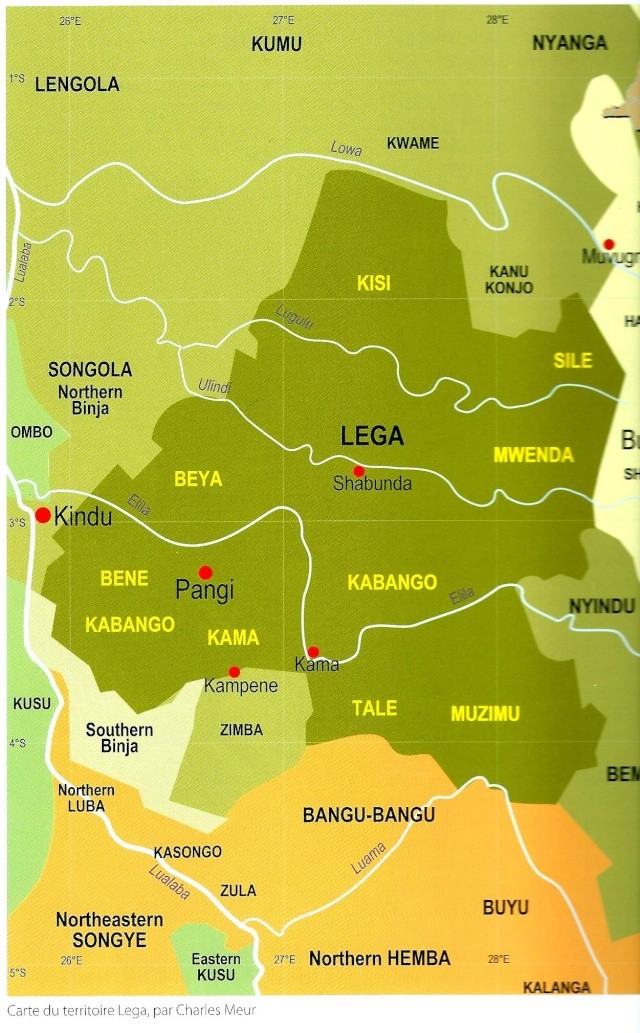
Kivu map (Congo)

Bibliography

Delhaize, Cdt, 1909. Les Warega (Congo belge), A. Dewit, Bruxelles.
Biebuyck, Daniel P.
– 1953a. « Maternal uncles and Sororal Nephews among the Lega”, in Report on the Second Joint Conference on Research in the Social Science in East and Central Africa, Makerere College, Kampala, pp. 122-133.
– 1953b. « Répartition et droits du pangolin chez les Balega », Zaïre 7, pp.899-934.
– 1973. Lega Culture. Art, initiation and Moral Philosophy among a Central African People, University of of California Press, Berkeley and Los Angeles.
– 1982a. “Lega Dress as Cultural Artefact”, African Arts, n°15, pp. 59-65, 92.
– 1982b. “Plurifrontal figurines in Lega Art in Zaire”, in The Shape of the Past. Studies in Giogio Buccellati & Charles Speroni (Ed.), Studies in Honor of Franklin D. Murphy, University of California, Los Angeles.
– 1983. “Lega Spoons,” in H. Burssens (ed.), Liber memorialis for Professor Vandenhoute, 1913-1978, Ghent, Belgium, pp. 51-66.
– 1986. The Art of Zaïre, vol II : Eastern Zaire, University of California Press, Berkeley, Los Angeles, Londres.
– 1994. La sculpture des Lega, Galerie Hélène Leloup, Paris, New York.
– 2002. Lega. Ethique et beauté au coeur de l’Afrique, KBC Banque & Assurance, Snoeck-Ducaju & Zoon, Gand.
Botne, Robert, 1994. A Lega and English Dictionnary, Rüdiger Köppe Verlag, Cologne.
Cameron, Elizabeth L., 2001. Art of the Lega, Fowler Museum of Cultural History, Los Angeles.
Defour, Georges, 1981. La corde de la sagesse lega, Editions Bandari, Bukavu, RDC.
Georges, Emile-Alexandre, 2005. Les Lega et leur Art. Sur les traces d’un rêveur égaré au Congoland, Musée royal de l’Afrique centrale, Tervuren.
Cameron, Elizabeth L. 2013, Secret d’ivoire. L’art des Lega, Muséed Quai Branly, Paris

paladi11
Courtesy Mimmo Paladino


Lega people, Mokolo (Mukulu) figure, Shabunda Région, Kivu, Congo

Avorio, patina d’uso, sostanza magica
H. cm.29
XIX sec.
Coll. privata, Italia

Provenienza

Mwami Ya Kindi Ngengele coll., Tusisi (Geo code: latit. -3,0833333 / longit. 27,2 ), Shabunda area, Sud Kivu, Congo

Pubblicazioni

Marc Leo Felix “ White gold, black hands. Ivory sculpture in Congo”
Vol VI, Edited by Marc Leo Felix, Brussels, Belgium, 2013, pag. 38, fig. A114, color

Questo oggetto è appartenuto al vecchio Mwami Ya Kindi Ngengele di Tusisi e la sua opinione è che è il più antico Mokolo dell’area di Shabunda e precede l’arrivo dei belgi.

lega_m13

Questo oggetto chiamato infatti, Mokolo Lwa Kindi, era infisso nel suolo dove si svolgevano importanti cerimonie e serviva per allontanare gli spiriti maligni ed i sorciers.
Sul corpo della Mokolo è presente la sostanza magica. Un altro esemplare con la sostanza magica (cm19) si trova al Museo Tervuren in Belgio, numero d’inventario EO.1974.21.18.

lega_m14

Altra interpretazione relativa a questo oggetto:

I pioli di osso d’elefante rappresentano le costole dell’elefante stesso, e sono le vestigia dei molteplici significati che di fatto il Bwami assegna a questo animale. L’immagine dell’elefante morto, decomposto, con sue costole visibili, viene evocato nel detto “Dove marcisce l’elefante, lì ci sono molte costole”.
Il detto, in combinazione con i pioli, si riferisce al possesso dei beni materiali di un membro di alto livello quale il Bwami, beni che sono poi distribuiti al momento della sua morte. (Biebuyck 1986, 191)

carta_10

Elio Revera


Testa E Croce nella cultura funeraria dei Kota

La passata aggiudicazione multimilionaria del reliquiario Kota appartenuto a William Rubin, ha posto sotto i riflettori questo oggetto della tradizione funeraria dei Kota.

Ma cosa sappiamo precisamente di questo popolo?

Malgrado gli indispensabili approfondimenti di vari studiosi e tra questi E. Andersson, J.C. Andrault, L. Perrois,  A.e F. Chaffin, I. Bolz, G. Delorme, J. Germain e Frederic Cloth con il suo approccio algoritmico/matematico, tante domande sono ancora senza risposta.
Assistiamo cioè al paradosso che di questo oggetto, forse il più conosciuto ed apprezzato in occidente per la sua seducente iconografia, tanto da essere collezionato anche da chi non ha l’arte africana tra i suoi principali interessi, conosciamo ben poco e quel poco, sovente, è soltanto il risultato di ipotesi e supposizioni.

Partiamo dal nome: Kota.

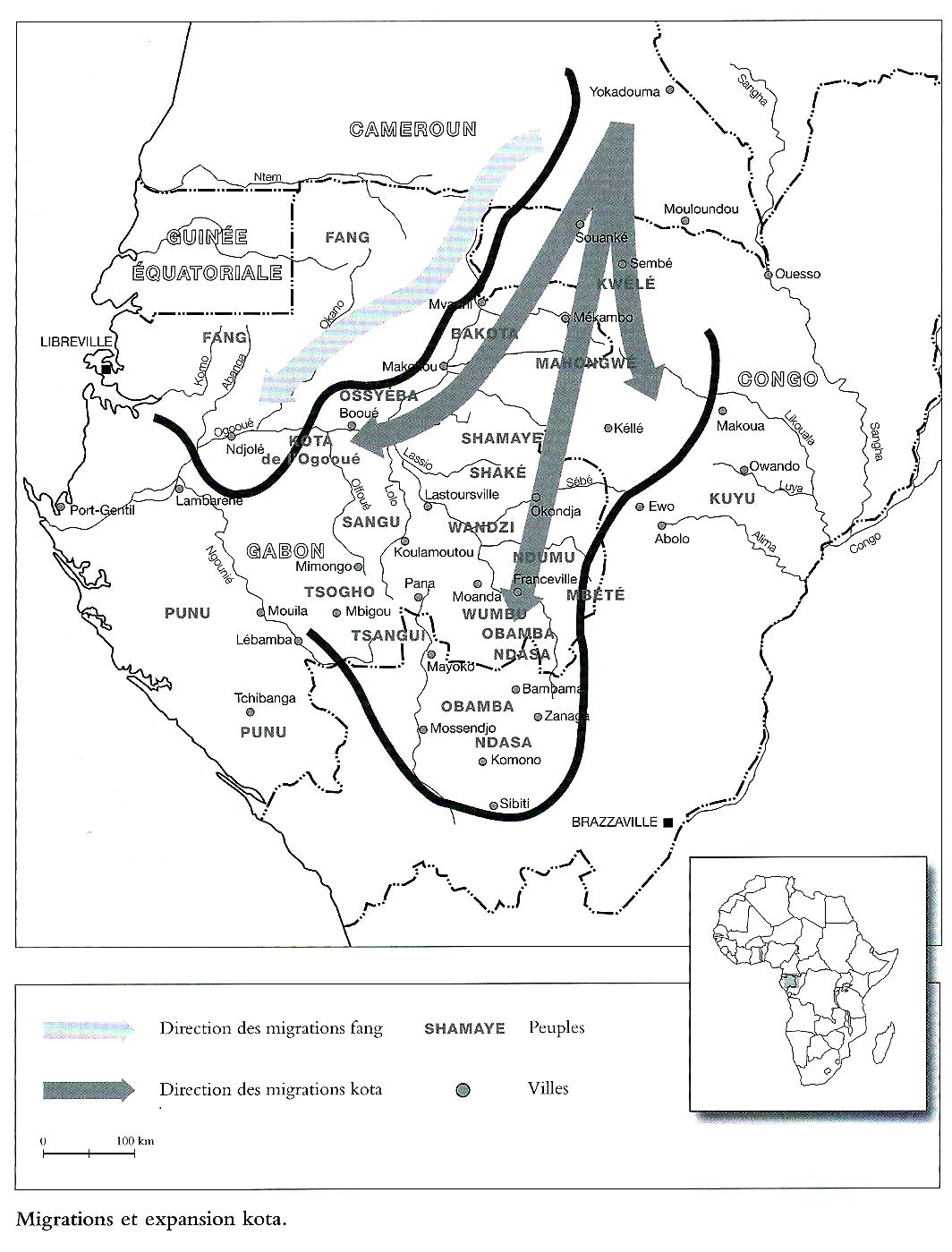
In realtà con questa definizione e con la definizione di Art Kota, si designano diversi raggruppamenti etnici caratterizzati da diversità ben marcate anche se appartenenti al medesimo ceppo linguistico culturale, quali i Bakota, Mahongwé, Shaké, Ndambomo, Shamaye a nord del fiume Ogooué nel Gabon orientale ed i Mindomou, Bakanigui , Bawumbu, Mindassa, Bakélé a sud, col bel risultato che i reliquiari tra i più apprezzati, appartengono ad un gruppo etnico meridionale, quella degli Obamba, che peraltro non si riconoscono appartenenti alla famiglia Kota.

elio1
Courtesy: L. Perrois, “Kota”, 2012, Vision d’Afrique, 5 Continents ed., Milano

Quando ha avuto inizio questa arte funeraria? Dove? Per iniziativa di chi? Secondo quali influssi stilistici e con quale evoluzione?
Perfino dettagli tecnico/tecnologici sono ancora avvolti nel mistero.
Come mai l’utilizzo impressionante, se non esclusivo, del rame e dell’ottone in una regione priva, o quasi, di giacimenti di cuprite? Da dove proveniva, allora questo metallo?
Come ha scritto Delorme,” les prospections que nous avons personnellement conduites dans ces régions pendant près de vingt ans n’ont donné aucun résultat positif ”. ( Réflexions sur l’art funéraire Kota).

Charles Stephen-Chauvet, L'Art funeraire au Gabon, Immaculee, Castres, France, 1933
Courtesy photo published in: Chauvet (Stephen), “l’Art Funéraire au Gabon”, Paris: Maloine, 1933: p. 2, #3.

Non è certo questa la sede per valutare questi interrogativi dal momento che sono disponibili diversi contributi in merito, sebbene, però, a taluni interrogativi la ricerca attuale non ha ancora fornito risposte decisive.
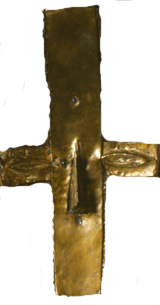
In questo mio scritto ciò che mi preme sostenere è una precisa tesi e cioè che l’evoluzione stilistica dell’arte funeraria dei Kota, a partire dal XVII/XVIII secolo, ed in particolare il motivo della croce realizzato con lamine di rame sul viso ovoidale del reliquiario (Mbulu Ngulu), è il risultato di due fattori preponderanti: l’incontro con la cultura religiosa cristiana e la sua conseguente diffusione e l’apporto massiccio del rame introdotto dagli europei in quelle regioni.

Ovviamente sono consapevole che il motivo cruciforme, come tanti altri stilemi, costituisce un archetipo appartenente alla cultura universale dell’umanità e di sicuro era ben presente in svariate rappresentazioni anche in Africa.

“L’ingegno umano, in culture cronologicamente e geograficamente molto differenziate, produce stilemi assolutamente sovrapponibili…
La croce appare nella simbologia rupestre, nelle terrecotte archeologiche, nelle tradizioni Tellem e Dogon arcaiche, nelle scarificazioni congolesi Pende, Chokwe …kings-of-africa nelle costruzioni pittoriche dei visi e delle maschere, persino nello schematismo “ideale” dell’abbozzo scultoreo delle maschere presso la stragrande maggioranza delle etnie.” (Beppe Berna)
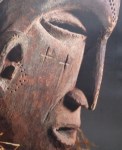
La peculiarità che caratterizza lo sviluppo dell’elemento cruciforme nella cultura Kota, peró, è la pressochè sua coincidenza con la diffusione della cultura religiosa europea in quelle terre e il suo radicamento in tutti i sottogruppi etnici con modalità praticamente esclusiva.
Per questo sostengo che il catalizzatore della diffusione iconografica della croce, evento che si è protratto per decenni, sia stata la cultura religiosa, proprio per il fatto che ha riguardato una vastissima area geografica e coinvolto tanti gruppi etnici di estrazione culturale e tradizioni a volte ben difformi.

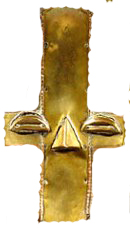
A fini illustrativi, ho isolato dal volto ovoidale di alcuni reliquiari conosciuti l’elemento cruciforme.
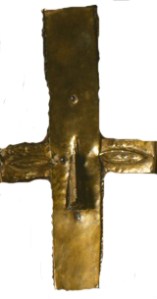
kota pecileimagecoonerinterview3

E’ stato scritto che è ben difficile stabilire dove e quando è nata l’arte funeraria Kota. Verosimilmente nel X sec., epoca in cui pare sia iniziato l’utilizzo del poco rame prodotto localmente e si sia sviluppata gradualmente fino all’arrivo degli europei, avvenuto alla fine del XV sec. e poi successivamente per tutto il XIX sec.

I portoghesi, infatti, verso la fine del ‘400 arrivarono in Congo, ( il primo europeo a visitare il Regno del Congo fu l’esploratore portoghese Diogo Cão, che visitò la costa africana fra il 1482 e il 1483 ), spingendosi poi a nord verso il Gabon.

Nella Monumenta Missionaria Africana di Padre António Brásio (1471/1531), rivolta alla storia del Portogallo nella regione del Golfo di Guinea, è scritto che le coste del Gabon furono sotto la dipendenza dell’Arcivescovado di S. Tomé, fondato nel 1534 , il cui primo titolare fu D. Diogo Ortiz de Vihegas. (Recherches sur la présance portugaise au Gabon. Robert Reynard, in Bollettin Hispanique, Tome 57, N.4, 1955, pp 415/416).

E’ poi con il missionario francese Jean-Rémi Bessieux della Congregazione dello Spirito Santo, che nella prima metà del XIX secolo, si diffonde su larga scala l’evangelizzazione del Gabon (http://www.dacb.org/stories/gabon/f-bessieux_jeanremi.html).
Nel 1863 nasce il vicariato apostolico del Gabon, allora denominato delle Due Guinee.

Queste informazioni sono importanti nella definizione dell’influenza della cultura cattolica in quelle regioni, della sua progressiva penetrazione e radicamento nei territori che, giova ricordarlo, non erano appannaggio soltanto dei missionari, ma anche di marinai, commercianti, trafficanti, amministratori ecc… di origine europea e specificatamente, in primis, portoghese.
Nel XVI secolo alla presenza portoghese si aggiunse quella di mercanti inglesi, francesi e olandesi.

Tutta la letteratura in merito, quando approfondisce l’evoluzione dello stile dei reliquiari Kota, è concorde nel considerare con ogni probabilità i Mahongwé quali iniziatori di questa forma di arte, stante anche la lavorazione e la tecnica di decorazione con i fili di rame, forma questa diffusa nell’Africa pre-coloniale.
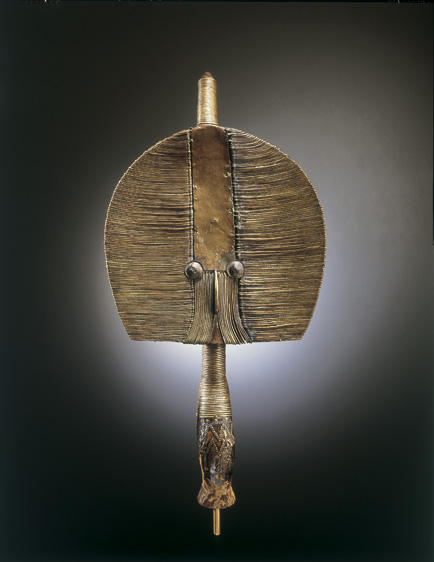
04/01Gabon

Courtesy Musée Dapper, Parigi

L’evoluzione stilistica successiva a quella Mahongwé circa i reliquari Kota. è quella dello stile denominato Shamaye .
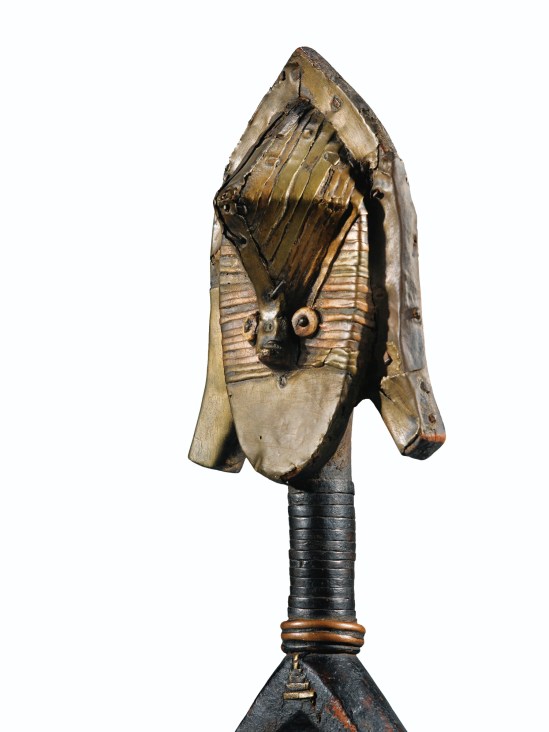
sothebys shamayeCourtesy Sotheby’s.

Questi sono ritenuti gli stili originari e da essi derivano i successivi, chiamati con qualche approssimazione “classici”. Sono questi i reliquiari con il viso piatto/ concavo ed i successivi denominati semi-ronde-bosse (mezzo tondo) e ronde-bosse (tutto-tondo) o convesso, considerati più tardivi nell’evoluzione dello stile Kota.
“Quoique les types concave et convexe aient apparemment coexisté, il semblerait que ces premiers soient plus anciens (Perrois 1985:48), la concavité pouvant apparaître à la rigueur comme un trait archétypal dérivé de l’art mahongoué qui précede effectivement d’un tel schéma de construction” (J. Germain, AAN n. 117, 2001, p.19).
Giova ricordare, en passant, che in ogni caso già verso la metà del XIX sec. tutti gli stili Kota erano rappresentati e conosciuti (J. Germain); da qui in avanti non ci saranno altri sviluppi stilistici e l’utilizzo stesso dei reliquiari sarà meno diffuso per scomparire del tutto verso i primi decenni del XX sec.

Ritornando al nostra ipotesi, questo brevissimo excursus dell’evoluzione e classificazione dello stile Kota, peraltro già magistralmente definito da Perrois, Chauffin e Delorme, evidenzia un punto nodale.
Sia la produzione Maohngwé che quella Shamaye, circa il 17% di tutto il corpus conosciuto dei reliquiari, cioè quelle produzioni che hanno originato lo stile, non presentano in nessuna forma e con nessuna apparenza l’elemento cruciforme, presente al contrario nello stile “classico”, quello presumibilmente sviluppatosi a partire dalla metà del XVIII con la diffusione e la penetrazione dell’evangelizzazione cristiano/cattolica. (v. “Les travaux et les jours de la Mission Sainte-Marie du Gabon (1845-1880). Agriculture et modernisation” di Odette Tornezy in Revue française d’histoire d’outre-mer-Année 1984-Volume 71-Numéro 264 pp. 147-190)

In nessun modo i reliquiari iniziali suggeriscono la forma della croce; nulla rimanda a quell’elemento!
Ed allora perché tra le mille forme evolutive possibili, proprio la croce compare sui volti dei Kota “ classici” salvo nuovamente scomparire, almeno in parte, su quelli successivi ronde e demi-ronde?

Un caso? Una bizzarria dell’artista? Una coincidenza?

A mio parere, nulla di tutto questo.

Fosse stato un caso o la creatività di un artigiano, come spiegare la sua diffusione in tutto i territori Kota? Come immaginare che nessun altro fabbro potesse aver avuto l’idea di dare vita ad un’altra forma?

No, la presenza della croce sui volti dei Kota classici dipende a mio avviso da un unico elemento: la diffusa pregnanza della croce, della sua iconografia, nelle immagini, negli oggetti di culto, in tutto quell’apparato religioso della cultura cattolica che si radicava man mano in quei territori.
Questo, a mio parere, spiega la presenza dell’iconografia della croce sui visi astratti dei reliquari della generazione successiva ai Maohngwé e Shamaye.

Ovviamente tutto questo non significa affatto l’attribuzione di un sia pur recondito significato religioso cattolico ai Kota; niente di tutto ciò se non l’innato sincretismo della creatività dei popoli africani che spesso hanno tradotto in forme artistiche autoctone gli stimoli provenienti da altre culture che evidentemente avevano colpito la loro fantasia ed immaginazione.

La diffusione poi a partire dal XVII sec. del rame dell’Angola in particolare, introdotto via via massicciamente dagli europei, prima portoghesi, poi olandesi, inglesi, tedeschi e francesi ed il cui apice fu nel XIX sec., ha favorito la creazione e la realizzazione dei reliquiari Kota; mano a mano i fabbri hanno affinato la tecnica di lavorazione, non disdegnando affatto il raro e pregiato rame rosso locale e passando anche all’utilizzo di lamelle e lamelle lavorate a guisa di fili, invece del filo di rame originariamente utilizzato dai Maohngué e Shamaye.

Non è il caso qui di sottolineare come l’evoluzione dello stile non è da intendersi in modo lineare e meccanicistico: spesso gli stili si compenetrano, si amalgamano e non è difficile riscontare nello stesso raggruppamento etnico, la presenza di stili diversi.

Rimane da interpretare la quasi scomparsa dell’elemento cruciforme negli stili evolutivi considerati più tardivi, quelli ronde e semi-ronde.
A mio avviso per un motivo di ordine pratico e percettivo. La croce quale elemento iconografico di novità, ha cessato di essere tale fin dall’inizio del XIX sec. stante la diffusione della cultura cattolica in quei territori; a questo punto, la creatività dei fabbri Kota si è rivolta ad altri stimoli e ha dato vita a quello stile “convesso” che è ritenuto da tutta la letteratura l’ultimo dello sviluppo stilistico/ artistico dei Mbulu Ngulu Kota.

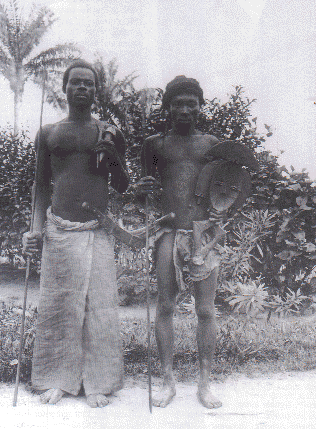
Hunters obamba photographed by E Anderson in the area of
Hunters Obamba photographed by E. Andersson

In conclusione, voglio porre l’attenzione su di un elemento certamente secondario, ma non per questo degno di minore attenzione.
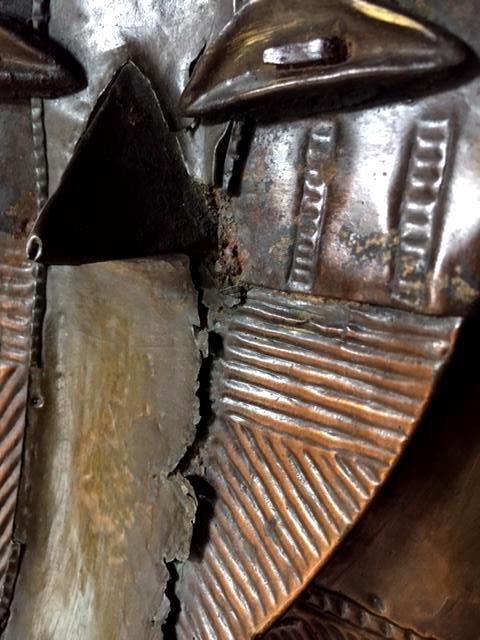
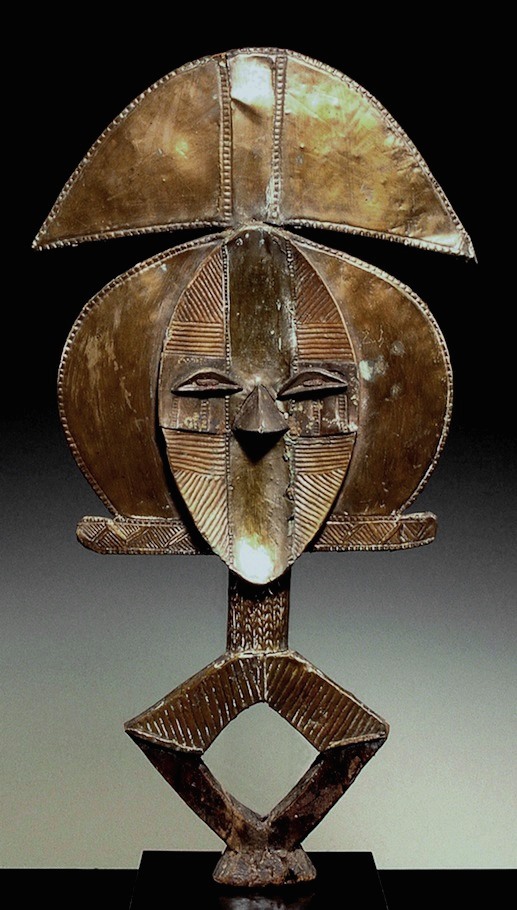
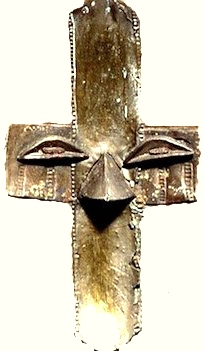
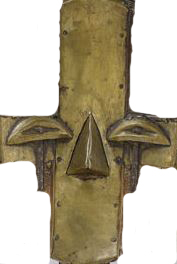
Esistono rari, anzi rarissimi reliquiari “classici”, ma anche convessi, che presentano il motivo definito “en larmes”, cioè reliquiari in lacrime.
23 (2)reliquary_L2_africa_1031
Questi reliquiari presentano sotto gli occhi una o due strisce verticali di colore e lavorazione diversa dal resto del viso che effettivamente paiono delle lacrime. L’interpretazione corrente è che si tratti della rappresentazione di incisioni rituali.

Volto

Io non concordo con questa affermazione.
Anzitutto perché queste “lacrime” se rappresentassero delle incisioni rituali sarebbero ben più diffuse su tanti reliquiari ed invece, come detto, sono rarissimi gli esemplari che le contemplano.
Non sono certo il frutto del caso o dell’invenzione estemporanea perché, per quanto rare, sono comunque riscontrabili in diversi reliquiari di stili diversi.
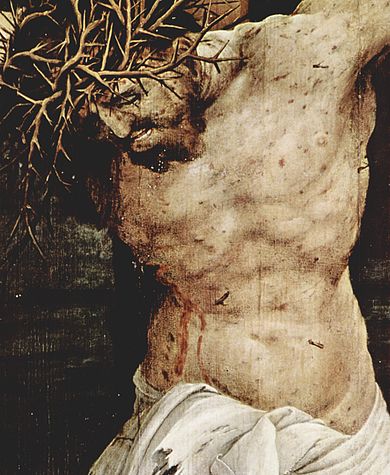
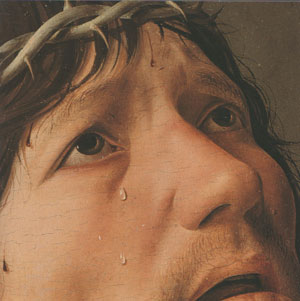
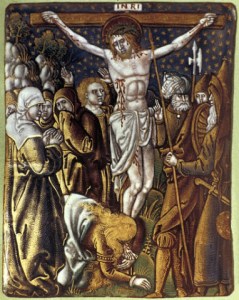
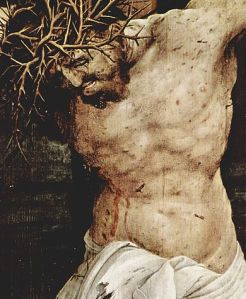
La mia personale interpretazione, e sottolineo interpretazione, è che quelle linee verticali poste sotto gli occhi, rappresentino realmente delle lacrime o in alternativa dei fiotti di sangue quali quelli visibilissimi in tutta l’iconografia cristiano medioevale, specie dei paesi del centro Europa, ma anche in quelli latini.
Crocifissione. Cristo sulla croce dopo che è stato trafitto dalla lancia del soldato, Leonard Limousin (c1505c1577)390px-Mathis_Gothart_Grünewald_059cristo_alla_colonna_2
Credo che queste immagini, (Leonard Limousin, Mathis Grünewald ed Antonello da Messina), così veriste e dirette che rappresentavano lacrime e fiotti di sangue sul volto e sul corpo di Cristo sulla croce, fossero patrimonio iconografico dei missionari e dei religiosi e che da loro venisse utilizzato nella quotidiana liturgia cristiana.
Tali immagini, io penso, abbiano realmente impressionato i locali al punto da indurli a rappresentarle secondo i propri canoni sui loro reliquiari. Di conseguenza, ritengo che per questi reliquiari si possa ipotizzare a ragion veduta una forte anzianità stante l’indelebile impressione suscitata inizialmente da quelle immagini che naturalmente, nel tempo, si è stemperata, come accade parimenti per ogni novità.

23
Mbulu Ngulu “en larmes” di tipo “classico”. Area culturale del sottogruppo etnico dei Mindassa o Obamba, Kota del sud, regione di Mounana. Prob. inizio XIX sec. Ex coll. Arman, New York.

Le Fonti. Bibliografia. Courtesy Gabriele Bortolami.

-Annibale Tavarone da Genova, (1712), Viaggio di Affrica e America Portughesa. (Testo inedito del XVIII), a cura di Carlo Toso, Roma 2001, Istituto Storico dei Cappuccini.
-Antonio Zucchelli da Gradisca, (1712), Relazioni del viaggio é Missione di Congo Nell’Etiopia Inferiore Occidentale (…). Nelle quali si descrive attentamente tutto ciò che di notabile è occorso di vedere, ed operare al suddetto P.Missionario, sì nè lunghi viaggi da lui fatti, come pure nell’esercizio della Missione (…), In Venezia, per Bartolomeo Giavarina.
-António de Oliveira de Cadornega, (1972), História Geral das Guerras Angolanas 1680, 3 vol., a cura di José Matias Delgado, Lisboa, Agência Geral do Ultramar.
-Bernardino Ignazio d’Asti, (1747), Missione in prattica de Padri Cappuccini ne Regni di Congo, Angola, et adiacenti, Torino, Biblioteca Civica, ms. 457.
-Bernardo da Gallo, (1710), Conto della Villacazione missionale, Archivio de Propaganda Fide (APF), serie Scritture Originali riferite nelle Congregazione Generale (SOCG), 576.
-Bonaventura de Ceriana, (1790), Instrumento em publica forma, Luanda, pro manuscripto.
-Bontinck F. (ed), (1964), Jean-François de Rome, Brève relation de la fondation de la mission des Frères Mineurs Capucins du Séraphique Père Saint François au royaume de Congo, Louvain-Paris, Nauwelaerts.
-Brásio A. (1952), Monumenta Missionaria Africana. África Ocidental (1471-1531), Lisboa, Agência Geral do Ultramar.
-Brásio A. (1953), Monumenta Missionaria Africana. África Ocidental (1532-1569),Vol. 2, Lisboa, Agência Geral do Ultramar.
-Buenaventura de Carrocera, (1946), Dos relaciones ineditas sobre la mision capuchina del Congo, Roma, Istituto Storico dei Frati Minori Cappuccini.
-Giovanni Antonio Cavazzi da Montecuccolo, (1690a), Istorica Descrittjone dé tre regni Congo, Matamba et Angola situati nell’Etiopia inferiore occidentale e delle missioni apostoliche esercitatevi da religiosi cappuccini, Milano, Nelle stampe dell’Agnelli.
-Giovanni Antonio Cavazzi da Montecuccolo, (1690b), Istorica Descrittjone dé tre regni Congo, Matamba et Angola situati nell’Etiopia inferiore occidentale e delle missioni apostoliche esercitatevi da religiosi cappuccini, Milano, Nelle stampe dell’Agnelli [trad. port. di Graziano da Leguzzano, Descrição Histórica dos três Reinos do Congo, Matamba e Angola = Agrupamentos de estudos de Cartografia Antiga 2, Lisboa, Junta de Investigação do Ultramar, 1965
-Cherubino da Savona. (1775), Breve Ragguaglio del Regno di Congo, e sue Missioni, in Toso C. (1976), Il Congo nella seconda met{ del XVIII secolo. Il “Breve Ragguaglio” di P. Cherubino da Savona, Roma, L’Italia francescana..
-Cordeiro L. (1881), Viagens explorações e conquistas dos portuguezes. Collecção de documentos. 1574-1620, Lisboa, Memorias do Ultramar.
-Cuvelier J. (1952), Le Père Bonaventure d’Alessano Capucin, Missionnaire au Congo (1645-1651), in “Revue du Clergé Africain” n. 9, pp. 1-19.
-Cuvelier J. (ed), (1953), Laurent de Lucques, Relations sur le Congo du Père Laurent de Lucques (1700-1717) = Mémoires XXXII, 2, Bruxelles, Institut Royal Colonial Belge.
-Cuvelier J. (19724), Nkutama a Mvila za Makanda, Matadi, Signum Fidei.
-Dapper O. (1686), Description de l’Afrique, Amsterdam, Wolfgang, Waesberge, Boom & van Someren.
-Demeneghi De Emidio (1971-1977), Cronaca della Missione, Cainzudi, pro manuscripto.
-Ferrario G. (1825), Il costume antico e moderno. Africa, vol. 3, Firenze, Vincenzo Batelli.
-Filippo da Firenze (1711), Ragguagli del Congo cioè Viaggi fatti da’ Missionarij Apostolici Cappuccini della Proũa di Toscana | Regni del Congo, Angola, Matamba, &cc., Firenze, Archivio Provinciale Cappuccini, pro manuscripto.
-Francesco Maria Gioia da Napoli (1669), La meravigliosa conversione alla santa fede di Cristo della regina Singa, e del suo regno di Matamba nell’Africa Meridionale, in Napoli, per Giacinto Passaro.
-Giovanni Francesco Romano (1649), Breve Relatione Del Successo della Missione Dé Frati Minori Capuccini del Serafico Padre San Francesco Al Regno del Congo E delle qualità, costumi, e maniere di vivere di quel Regno, e suoi habitatori, In Milano, Ad Instãza di Francesco Mognaga.
-Girolamo Merolla da Sorrento, (1726), Relazione del viaggio nel Regno di Congo nell’Africa Meridionale (…) Continente variati Clima, Arie, Animali, fiumi, frutti vestimenti con proprie figure, diversità di costumi, e di viveri per l’uso umano. Scritto e ridotto nel presente stile Istorico, e narrativo dal P. Angelo Piccardo da Napoli predicatore dell’istesso Ordine. Diviso in due parti, In Napoli.
-Girolamo da Montesarchio, (1646), Viaggio del Ghongo, cio è Relatione scritta da un nostro missionario Capuccino, Firenze, Archivio Provinciale Cappuccini, pro manuscripto.
-Giuseppe da Modena, (1723), Viaggio al Congo, Luanda, in Piazza C. (1973), La missione del Soyo (1713-1716) nella relazione inedita di Giuseppe da Modena OFM Cap., in “L’Italia Francescana”, Roma, 56, 1980, 385-471.
-Guattini M.- De Carli D. (1674), Viaggio del Padre Michael Angelo de Guattini da Reggio, Et de P. Dionigi de Carli da Piacenza Capuccini, Predicatori, & Missionarij Apostolici nel Regno del Congo, Bologna, Gioseffo Longhi.
-Hyacintho Brusciotto a Vetralla (1659), Regulae quaedam pro difficillimi Congensium idiomatis faciliori captu ad grammaticae normam redactae a F. Hyacintho Brusciotto a Vetralla Concionatore Capuccino Regni Congi Apostolicae Missionis Praefecto, Romae, Typis S.Congr. de Prop. Fide.
-Johnston H. (1908), George Grenfell and the Congo. 2 Vol., London, Hutchinson.
-Joris van Gheel, (1652), Vocabularium Latinum, Hispanicum e Congense. Ad Usum Missionarũ transmittendum ad Regni Congi Missiones, Roma, Biblioteca Nazionale. [trad. ol. di Van Wing J.- Penders C., Le plus ancien Dictionnaire bantu. Vocabularium P. Georgii Gelensis, Bibliothèque Congo, Louvain, Imprimerie Kuyl-Otto, 1928.]
-Leite de Faria F. (1966), Uma relação de Rui de Pina sobre o Congo escrita em 1492, in “Studia”, vol. 19, pp. 223-303.
-Lorenzo da Lucca (1700), Relazioni d’alcuni Missionari Capp:ni toscani singolarmente del P.Lorenzo da Lucca che due volte fù Miss:io Apostol:co al Congo, Firenze, Archivio Provinciale Cappuccini, pro manuscripto.
-Luca da Caltanissetta (1690-1701), Relatione della missione fatta nel regno di Congo, [trad. fr. di François Bontinck, Diaire Congolaise (1670-1701) = Publications de l’Université de Lovanium de Kinshasa 24, Louvain-Paris, Nauwelaerts, 1970].
-Marcellino d’Atri (1690), Giornate Apostoliche fatte da me Fra Marcellino d’Atri, predicator cappuccino nelle messioni de Regni d’Angola e Congo nella Etiopia inferiore parte occidentale dell’Africa, a cura di -Carlo Toso (1984), in “L’anarchia congolese nel sec. XVII. La relazione inedita di Marcellino d’Atri” = Università di Genova, Facoltà di Lettere e Filosofia. Studi di storia delle esplorazioni 15, Genova, Bozzi.
-Pellicer de Tovar I. (1649), Mission Evangelica al Reyno de Congo, Madrid, Domingo Garcia i Morràs, http://adrastea.ugr.es , consultato in dicembre 2009.
-Pigafetta F. (1978), Relazione del reame di Congo, a cura di Giorgio Cardona = Nuova Corona 8, Milano, Bompiani.
-Pigafetta F. (1591), Relatione del Reame di Congo et delle circonvicine contrade. Tratta dalli Scritti & ragionamenti di Odoardo Lopez Portoghese (…) Con disegni Vari di Geografia, di piante, d’habiti, d’animali, & altro, Roma, Appresso Bartolomeo Grassi.
-Proyart B.L. (1776), Histoire de Loango, Kakongo, et autres royaumes d’Afrique, Paris – Lyon, Berton-Crapart, Bruyset-Ponthus
-Raphael de Castelo de Vide, (1781), Viagem e Missão no Congo, http://www.arlindo-correia.com/121208.html, maggio 2009.
-Raimondo da Dicomano, (1798), Informazione sul Regno del Congo, http://www.arlindo-correia.com/121208.html, maggio 2009.

Elio Revera

Per altre referenze bibliografiche rimando ai mirabili lavori degli autori citati nel testo.

English version

Head And Cross in the burial culture of Kota.

The recent award of the multimillion Kota reliquary belonged to William Rubin, it has put the spotlight this issue in the funerary tradition of Kota.
But what do we know precisely of this ethnic group?
Despite the essential insights of various scholars and among them E. Andersson, JC Andrault, L. Perrois, Ae F. Chaffin, I. Bolz, G. Delorme, J. Germain and Frederic Cloth, many questions are still unanswered.
Ie we are witnessing the paradox that this item, perhaps the best known and appreciated in the West for its seductive iconography, as to be collected even by those who have African art among his main interests, we know very little and that little, often , it is only the result of assumptions and guesses.
We start with the name: Kota.
In fact with this definition and the definition of Art Kota, you designate different ethnic groupings characterized by diversity clearly marked even if they belong to the same linguistic family culture, which Bakota, Mahongwé, Shake, Ndambomo, Shamaye north of the river Ogooué in Gabon Eastern and Mindomou, Bakanigui, Bawumbu, Mindassa, Bakélé south, with good result that the relics of the most popular, belong to an ethnic group in southern, that of Obamba, which does not recognize members of the family Kota.
When did this Cemetery? Where? To whose initiative? According to such stylistic influences and how evolution?
Even technical / technological are still shrouded in mystery.
Why use impressive, if not exclusive, brass and copper in a region-free, or nearly so, of deposits of cuprite? Where it came from, then this metal?
As written by Delorme, “que nous avons les prospections personnellement conduites dans ces régions pendant près de vingt ans donné n’ont aucun résultat positif”. (Reflections on the Art funéraire Kota).
This is certainly not the place to evaluate these questions since there are several contributions about, although, however, to certain questions, current research has not provided conclusive answers.
In my writing what I would argue is a clear thesis, namely that the stylistic evolution of funerary art of Kota, in the seventeenth / eighteenth century, and particularly the reason of the cross made with copper foils on the face oval the reliquary, is the result of two overriding factors: the encounter with the Christian religious culture and its subsequent spread and the massive inflow of copper introduced by Europeans in those regions.
Obviously I am aware that the reason cruciform, like many other styles, is an archetype belonging to universal culture of mankind and certainly was very much present in several representations in Africa.
“Human ingenuity, in cultures chronologically and geographically very different, produces absolutely overlapping styles …
The cross appears in the symbolism rock, in archaeological pottery, archaic traditions Tellem and Dogon, in scarification Congolese Pende, Chokwe … kings-of-africa in construction painting faces and masks, even in the schematic “ideal” of the sketch of the sculpture masks at the vast majority of ethnic groups. “(Beppe Berna)

The uniqueness of the development cruciform element in the culture Kota to, however, is its almost coinciding with the spread of European religious culture in the land and its roots in all ethnic subgroups with virtually exclusive mode.
Why I maintain that the catalyst of the spread iconography of the cross, an event that has lasted for decades, it was the religious culture, precisely because it covered a wide geographical area involved and the many ethnic groups of cultural backgrounds and traditions sometimes well dissimilar.

It ‘was written that it is very difficult to determine where and when did the Cemetery Kota. Probably in the tenth century., By which time it seems to have started to use the little copper produced locally and has developed gradually until the arrival of Europeans, which occurred in the late fifteenth century. and even later
The Portuguese in fact towards the end of ‘400 arrived in the Congo (the first European to visit the Kingdom of Congo was the Portuguese explorer Diogo Cao, who visited the African coast between 1482 and 1483) then pushing north towards Gabon.
Monumenta in African Missionary Fr. Antonio Brasio (1471/1531), addressed to the history of Portugal in the Gulf of Guinea, has written that the coast of Gabon were under the dependence of the Archbishop of San Tomé, founded in 1534, whose first owner was D. Diogo Ortiz de Vihegas. (Recherches sur la présance portugaise au Gabon. Robert Reynard, in Bulletin hispanique, Tome 57, Ranked # 4, 1955, pp 415/416).
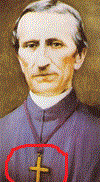
The French missionary Jean-Rémi Bessieux of the Congregation of the Holy Spirit, in the first half of the nineteenth century, develops large-scale evangelization of Gabon (http://www.dacb.org/stories/gabon/f-bessieux_jeanremi.html).
archb
Mgr. Jean-Rémi Bessieux

In 1863 he born the apostolic vicariate of Gabon, then called the Two Guineas.
This information is important in the definition of the influence of Catholic culture in those regions, its gradual penetration and rooting in the territories, it should be remembered, were not the prerogative only of missionaries but also of sailors, merchants, traders, administrators, etc … Source European and specifically, in the first place, the Portuguese.
In the sixteenth century the Portuguese presence is added to the merchants of British, French and Dutch.

All the literature about when deepens the evolution of the style of the Kota reliquaries, agrees to consider probably the Mahongwé as instigators of this art form, given also the processing and decoration technique with copper wires, shape this widespread in Africa pre-colonial.
The stylistic evolution after the one Mahongwé about Kota reliquaries. is that of the style called Shamaye.
These are believed to be the original style and derive from them the next, with some approximation called “classic”. These are reliquaries with the flat face / concave and subsequent called semi-ronde-bosse (half round) and ronde-bosse (all-round) or convex, considered more late in the evolution of the style Kota.
“Quoique les types concave et convexe aient apparemment coexisté, il semblerait que ces premiers soient plus anciens (Perrois 1985:48), la concavité pouvant apparaître à la rigueur comme un trait archétypal dérivé de l’art mahongoué qui précede effectivement d’un tel schéma de construction” (J. Germain, AAN n. 117, 2001, p.19).
To recall, in passing, that in any case by the middle of the nineteenth century. Kota all styles were represented and known (J. Germain); from now on there will be no other stylistic developments and the use of the same relics will be less widespread to disappear completely into the first decades of the twentieth century.
Returning to our hypothesis, this brief overview of the evolution and classification of style Kota, however masterfully defined by Perrois, Chauffin and Delorme, highlights a key point.
Both production Maohngwé that the Shamaye, about 17% of the entire corpus of known reliquaries, those productions that originated the style, not present in any form or by any appearance cruciform element, in contrast to this “classic “, that presumably developed from the middle of the eighteenth with the spread and penetration of the religious culture Christian / Catholic
(v. “Les travaux et les jours de la Mission Sainte-Marie du Gabon (1845-1880). Agriculture et modernisation” by Odette Tornezy, Revue française d’histoire d’outre-mer-Année 1984-Volume 71-Numéro 264 pp. 147-190).
In no way reliquaries initial suggest the shape of the cross; nothing points to that element!
And then because of the many possible forms of evolution, just the cross appears on the faces of Kota “classic” subject again disappear, at least in part, to successive rounds and demi-ronde?
A case? A quirk of the artist? A coincidence?
In my opinion, none of this.
It was an accident or the creativity of a craftsman, how to explain its spread throughout the territories Kota? How to imagine that no other locksmith might have had the idea of giving life to another form?
No, the presence of the cross on the faces of Kota classic depends in my opinion only one item: the widespread significance of the cross, his iconography, in images, objects of worship, all that apparatus religious Catholic culture that took root as in those territories.
This explains the presence of the cross on the faces abstract iconography of reliquaries of the next generation and to Maohngwé Shamaye.
Obviously this does not mean the assignment of an albeit hidden religious meaning to the Catholic Kota; none of this if not the syncretism of the innate creativity of the African peoples who have often translated into art forms indigenous knowledge from other cultures who had obviously hit their creativity and imagination.
The spread then in the seventeenth century. Copper Angola in particular, introduced by Europeans, first the Portuguese, then the Dutch, British, German and French whose apex was in the nineteenth century., has favored the creation and implementation of Kota reliquaries; As locksmiths have refined the technique of processing, not forgetting the rare red copper local and passing to the use of plates and strip worked like a wire instead of copper wire originally used by Maohngué and Shamaye.
There is no need here to stress that the evolution of style is not to be understood in a linear and mechanistic: often the styles mingle, merge and it’s not hard rediscount same ethnic grouping, the presence of different styles.
It remains to interpret the near disappearance element cruciform styles evolutionary considered more late, those rounds and semi-patrols.
I think for one reason practical and perceptive. The cross which iconographic element of novelty, has ceased to be from the beginning of the nineteenth century. given the spread of Catholic culture in those territories; At this point, the creativity of blacksmiths Kota turned to other stimuli and has created that style “convex” considered the last of the artistic development of Kota.
In conclusion, I want to focus on an element certainly secondary, but not worthy of less attention.
There are rare, indeed very rare reliquaries “classic”, but also convex, presenting the reason called “en larmes”, that is, reliquaries in tears.

Volto1

These shrines are under the eyes one or two vertical strips of color and processing different from the rest of the face and actually seem to tears. The current interpretation is that it is the representation of engravings rituals.
I do not agree with this statement.
First, because these “tears” if they represented incisions rituals would be far more widespread on many reliquaries and instead, as mentioned, there are very few examples that contemplate.
Are certainly not the result of chance or impromptu invention because, however rare, are still found in many reliquaries of different styles.
My personal interpretation, and I stress interpretation, is that those tears genuinely represent tears or alternatively the streams of blood such as highly visible throughout the medieval Christian iconography, especially the countries of Central Europe, but also in Latin.

Antonello da messina
Antonello da Messina

I think these images, so direct and veristic representing streams of blood and tears on the face and body of Christ on the cross, were iconographic heritage of missionaries and religious and that they were used in everyday Christian liturgy.
These images, I think, have really impressed the local to the point of inducing them to represent them according to their canons on their shrines. Accordingly, I believe that for these reliquaries one can assume with good reason a strong seniority because of the indelible impression made initially by those images which of course, in time, it is diluted, as also happens with anything new.

Elio Revera

Bibliography back up the wondrous works of the authors mentioned in the text.
Giacometti
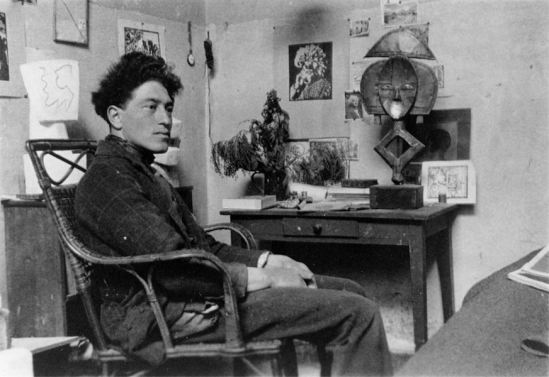
Alberto Giacometti accanto a un reliquiario Kota, 1927.

Kabyé people, Kara Region, Arcaic Female Figure, North Togo

kabye-jpeg

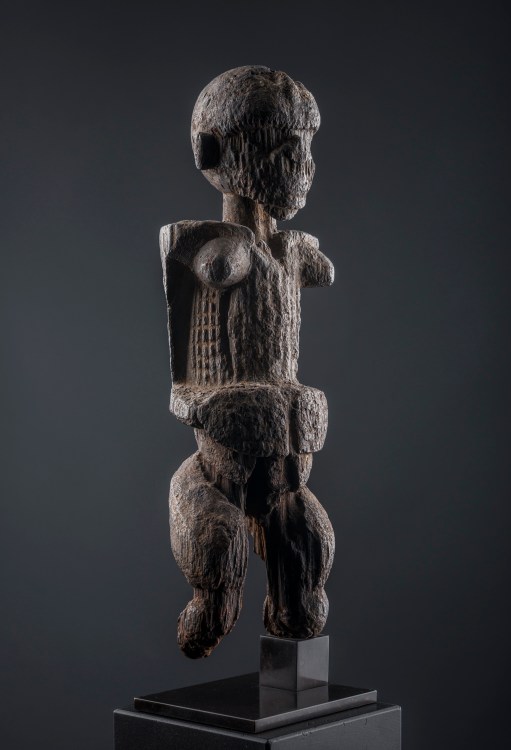
This hardwood sculpture (12 in/31cm), is the image of a female figure. The dense matter shows signs of heavy erosion, which leads to the opinion that the piece is of considerable age. Due both to its color and appearance, the object’s consistency bears a stone-like resemblance. Both feet are missing, and deposits of sacrificial matter can be seen on the sculpture.
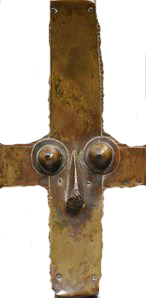
What characterizes this figure most of all is, firstly, the intense expressiveness of the face, which at times appears almost monkey-like with its bald head and the small crest on the forehead, emanating a kind of dark concentration, and secondly, the posture, characterized by a powerful and retained energy.

This feeling stems from the peculiar position of the exorbitantly long arms which, pushed so far behind and along the line of the figure’s back that the elbows almost touch, result in the dramatic backward curving of the figure’s shoulders, and consequently the extreme prominence of the bust.

The image of strength obtained by the position of the arms is slowly released and then establishes itself once again in the intertwined fingers of the imposing hands placed upon the stomach, giving the sculpture a sense of pride and vigor.

A pattern of small squares on both the cheeks and down the front of the torso shows evident scarifications.

Observing the sculpture from behind and in profile, an evident swelling of the abdomen is seen which the embrace of the imposing hands seems to protect.
The represented woman seems pregnant.
My hypothesis, therefore, is that this female sculpture was intended as a means of protection towards pregnancy or maternity.

In my opinion the sculpture of considerable age, is an arcaic figure that contain forerunner features of styles later developed in this area.

The iconography of this sculpture is characterized by an extreme rarity, and given that it is currently the only known figure with the characteristics described above, classification is therefore difficult.

“After further research I feel that figure may be Ishan. These objects are not well represented in the literature. They are north of Benin City and their art is influenced by the Bini, Igbirra and the Ibo. This attribution would account for the horizontal cut off of the forehead, the small rounded eyes, the position of the arms and the scarification on the torso. The figures also can have a downward pointing mouth.”
(Barry Hecht)

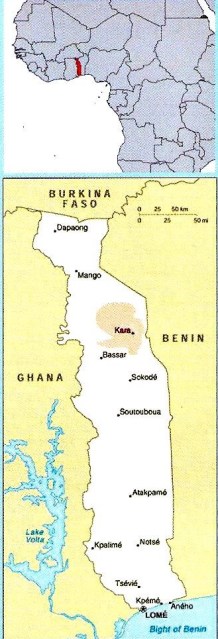
About his ethnic background, it is difficult to give an exact attribution. A group of sculptures with the same stylistic characteristics were brought in Germany in the late nineteenth century, with the generic attribution of Difale: but this is the name of a mountain village in the north of Togo, Kara Region, that at the time was a German colony.

togo

Republic of Togo

It appears more appropriate the attribution to the people of Kabyé, who lives in that area, given the posture and scarification on the face and body, both male and female figures.

 Bibliography:

J.C. Froelich, 1935, n°23 des Mémoires de l’IFAN Mélanges Ethnologiques, in particolare le tavole. VIII, IX et X
K. Krieger, West-Afrikanische Plastik I, 1978, p.27 a 29
R. Verdier, Le pays Kabyé, cité des dieux cité des hommes, 1982, Editions Karthala


kabye-dorso-jpeg

Kabyé people,  Kara Region, Arcaic Female Figure, North Togo
H.31 cm, Legno eroso e materiali sacrificali
Sec. XVIII-XIX prob.


La scultura in legno duro, è l’immagine di una figura femminile. La densa materia si presenta molto erosa e l’impressione è quella di un oggetto di grande anzianità. La scultura sia per il colore che l’aspetto rimanda ad una consistenza pietrosa. Mancano entrambi i piedi e sulla figura si rilevano depositi di materia sacrificale.

Ciò che caratterizza peculiarmente questa figura da un lato è l’intensa espressività del volto, a tratti scimmiesco, con la testa calva e una piccola cresta sulla fronte, che promana una scura concentrazione, e dall’altro la postura, caratterizzata da una potente e trattenuta energia.

Questa sensazione deriva dalla particolare posizione delle braccia, smisuratamente lunghe che, spinte all’indietro lungo la linea del dorso fino a quasi far toccare i gomiti, costringono la figura a curvare le spalle all’indietro e contemporaneamente a divaricare i pronunciati seni.

L’immagine di forza così ottenuta si scarica e si concentra sull’intreccio delle dita delle imponenti mani poste sul ventre che danno alla scultura fierezza e vigore.

Sono presenti evidenti scarificazioni a forma di piccoli regolari quadrati, sia sulle guance che sulla parte anteriore del tronco.

Un’ipotesi è che la figura fosse una rappresentazione della “ gravidanza” in considerazione del ventre prominente e delle mani intrecciate a protezione del medesimo.

La scultura di considerevole età, è rappresentativa di arcaici stilemi, precursori forse, degli stili sviluppatisi successivamente in quest’area.

L’iconografia di questa scultura si caratterizza per estrema rarità e pertanto risulta di difficile classificazione, costituendo, al momento, l’unica figura conosciuta con le caratteristiche sopra descritte.

“Dopo ulteriori ricerche penso che questa scultura possa essere Ishan, figure che non sono molto studiate in letteratura. Gli Ishan sono presenti a nord di Benin City e la loro arte è influenzata dai Bini, Igbirra e Ibo. Questa attribuzione si basa sul taglio orizzontale della fronte, i piccoli occhi arrotondati, la posizione delle braccia e la scarificazioni sul tronco. Queste figure possono avere anche la bocca che punta verso il basso. ” (Barry Hecht )

Circa la sua origine etnica, appare piuttosto difficile una precisa attribuzione. Un gruppo di sculture con le medesime caratteristiche stilistiche furono portate in Germania alla fine del XIX sec. con la generica attribuzione di Difale,  nome che però è quello di un villaggio nel montagnoso nord del Togo, allora colonia tedesca.

Più appropriata appare l’attribuzione al popolo dei Kabyé che vive in quell’area, stante la postura e le scarificazioni sul volto e sul corpo sia delle figure  maschili che femminili.

Riferimenti bibliografici specifici sono:

J.C. Froelich, 1935,  n°23 des Mémoires de l’IFAN Mélanges Ethnologiques, in particolare le tavole. VIII, IX et X

K. Krieger, West-Afrikanische Plastik I, 1978, p.27 a 29

R. Verdier Le pays Kabyé, cité des dieux cité des hommes, 1982, Editions Karthala


 Elio Revera

Sciarada d’estate…semiseria, neanche tanto a ben pensarci! (With the English version)

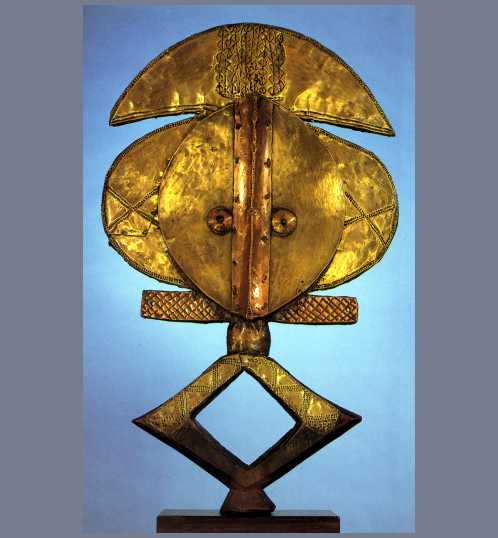
L’aggiudicazione del Rubin di Kota, pardon, del Kota di Rubin, lo scorso 23 giugno a Parigi, ha scosso gli animi, non soltanto per la cifra di aggiudicazione, cinque milioni e mezzo di euro circa, assolutamente spropositata rispetto a parimenti nobili oggetti di similare tipologia e fattura, quanto per l’imponente apparato scenico messo in atto dalla Chriestie’s.

rubin
Courtesy Yale University

Nulla di strano ovviamente…semplice e efficace politica commerciale, del tutto leggittima!

A me la cosa intriga per altri motivi e precisamente perché stuzzica il mio amore per due autori e per due generi letterali che io amo particolarmente.

Mi riferisco alle opere di Alexandre Dumas e di Robert Louis Stevenson.
E adesso vi spiego perché tali personaggi incrociano i loro destini con quello di Wiliam Rubin e del suo ex celeberrimo Kota.
Nel Visconte di Bragelonne, che tanti conoscono al cinema col film La maschera di ferro, Dumas ipotizza che viva segregato in una misteriosa torre, un povero cristo che oltre tutto porta sul volto una maschera di ferro che ne ottunde l’identità e che, misero, può soltanto parlare col suo confessore.
Questi non è altri che Filippo, gemello omozigote del re Luigi XIV, fatto da lui sparire perché non potesse ascendere legittimamente al trono di Francia.
Saranno i prodi moschettieri a svelarne la congiura e riportare il legittimo re, cioè Filippo, sul trono e rinchiudere l’usurpatore nella medesima segreta.

Ma che cacchio c’entra tutto ciò col Kota di Rubin, qualcuno si chiederà? Nulla ovviamente, se non la mia fervida fantasia.

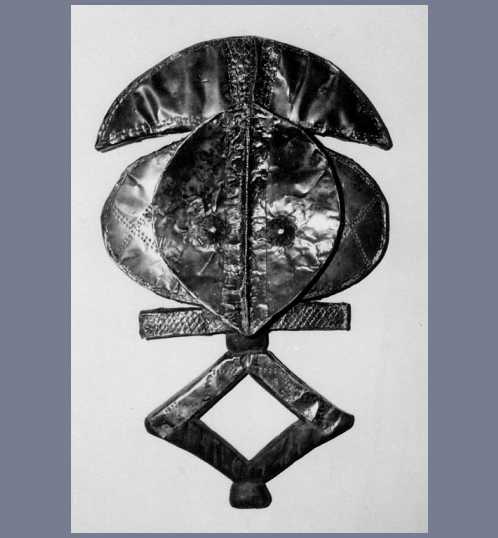
Esiste un Kota alquanto stropicciato e negletto, di cui si conoscono scarsissime informazioni che pare il gemello del Kota di Rubin.

Non ci credete? Ebbene guardate l’ immagine in bianco e nero…

56606
Courtesy Yale University

Non vi ricorda il nobile, perfetto, lustro e pimpante Kota da cinque milioni e passa della Christie’s?
A me si…eccome!!

Questo Kota è repertoriato al numero 56606 dell’Archivio dello Yale University e poverino…è sfigato a partire dal numero…con tutti quei 6 allineati, come ci ammonisce S.Giovanni nell’Apocalisse!

Ecco, io immagino questo kota poveretto, imprigionato in qualche torre chissà dove… la maschera stavolta è di rame d’accordo, sempre metallo, peró in ogni caso…che attende come Filippo l’arrivo di un prode moschettiere a restituirgli l’onore che merita, dal momento che è praticamente identico al tanto celebrato Kota di Rubin.

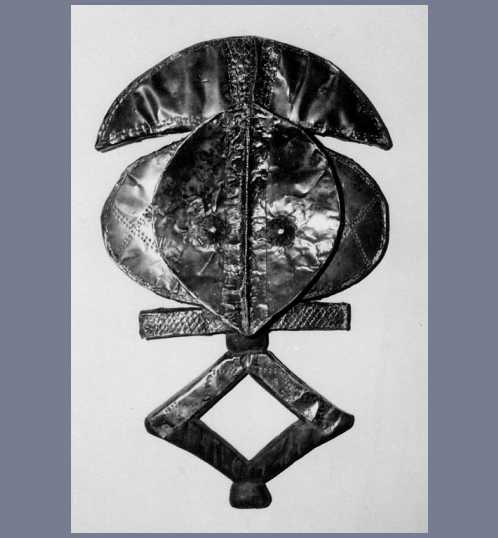
E se le immagini fossero invece quelle del medesimo oggetto?

56606rubin

Beh…qui è Robert Louis Stevenson a farla da padrone col suo magico Dott. Jekyll e mister Hyde.

Immaginate il nobile Jekyll che si trasforma in un perfido e sciupato Hyde e ne combina di tutti i colori fino a perdere la sua solare identità.

Se le immagini dei due kota fossero quelle dello stesso oggetto, ed io questo non so dirlo, la vicenda di Jekyll/Hyde sarebbe pressochè perfetta.

Da oscuro, acciaccato sconsolato e sconosciuto, ad abbagliante, luminoso e perfetto oggetto di desiderio…la metafora di Stevenson… capovolta!

Miracolo della scienza e della chirurgia estetica che a quanto pare non funziona soltanto sugli umani, bensì anche sugli oggetti d’arte come abbiamo imparato a conoscere.

A voi la scelta…Dumas o Stevenson…Bragelonne o Jekyll…in ogni caso….buona estate!!!

ENGLISH VERSION

Summer’s Charade … semi-serious, not too much thought about it!

The award of the Rubin Kota, pardon, the Kota Rubin, on June 23 in Paris, has shaken the minds, not only for the amount of the award five and a half million euro approximately, absolutely disproportionate compared to equally noble objects of similar type, but also for its impressive stage set implemented by Chriestie’s.

Nothing strange about that … simple and efficient business strategies!

To me it intrigues for other reasons, namely because it tickles my love for authors and for two literary genres that I particularly love.
I refer to the works of Alexandre Dumas and Robert Louis Stevenson.
And now I’ll explain why these characters cross paths with one of Wiliam Rubin and his former famous Kota.

In the Viscount de Bragelonne, that many know at cinema with the film The Iron Mask, Dumas assumed that living segregated in a mysterious tower, a poor man who leads all over the face of an iron mask that blunts the identity and that can only talk to his confessor.
This is none other than Philip, identical twin of King Louis XIV, that made him disappear because it could legitimately ascend to the throne of France.
Will the brave musketeers to unravel the conspiracy and restore the rightful king, that Philip, on the throne and shut the usurper in the same secret.

But what the hell does all this with Kota Rubin, someone will ask? Nothing of course, except my vivid imagination.
There is a Kota somewhat crumpled and neglected, that are known very little information that seems the twin of Kota Rubin.
Do not believe us? Well look at the ‘image in black and white …

Do not you remember the noble, perfect, shiny and perky Kota five million passes of Christie’s?
To me … all right !!
This Kota is indexed to the number 56606 of the Archives of Yale University and poor loser … is starting with … with all those 6 aligned, St. Giovanni admonishes us in the Apocalypse!
Behold, I guess this kota poor man, imprisoned in some tower somewhere … this time the mask is copper agree, always metal to, however, in any case … that awaits as Philip the arrival of a valiant musketeer to restore his honor it deserves, since it is virtually identical to the much celebrated Kota Rubin.

And if the pictures were instead those of the same object?
Well … here it is Robert Louis Stevenson to lord with his magical Dr. Jekyll and Mr. Hyde.
Imagine the noble Jekyll who turns into a treacherous and worn Hyde and combines all the colors until he lost his solar identity.
If the images of the two kota were those of the same object, and I say this I do not know, the story of Jekyll / Hyde is almost perfect.
From dark, bruised and dejected stranger to dazzling, bright and perfect object of desire … the metaphor of Stevenson … upside down!
Miracle of science and cosmetic surgery that apparently does not work only on humans but also on objects of art as we have come to know.

The choice is yours … … Bragelonne/Dumas or Stevenson/Jekyll … anyway … good summer !!!

Elio Revera

Igbo People, Ikenga, Aguleri-Umuleri Area (Igboland North-West), Nigeria


23,2 in/ 59 cm,
Wood, pigment color, earthy matter
Last quarter 19th century

Private collection, Italy
Photo by David Lorente/Zoom 3000 and Alessandro Ligato
Arti delle Mani Nere All Rights Reserved

Provenance
Pons coll., Barcelona
Angel Martin Gallery, Madrid

Exhibition
Bruneaf, 2010, Bruxelles
L’Africa delle Meraviglie. Arti Africane nelle collezioni italiane. Museo Palazzo Ducale, Genova, 31th December 2010 – 16th March 2011
Materia Negra, Fundacion Antonio Saura, Casa Zavala, Cuenca  (Spagna ), 18 th March/ 28 th May 2011

Published
– Bargna I, e Parodi da Passano G., L’Africa delle meraviglie – Arti africane nelle collezioni italiane, Genova, 2010, Silvana Editoriale, Cinisello Balsamo (MI), pag. 155, color
-AA.VV. “Materia Negra”, Edicion Fundacion Antonio Saura, Cuenca (Spagna), 2011, pag.186, 187 color

The Ikenga statuary is generally represented within the classical iconography from
a seated figure, powerful curved horns, fierce face  and the symbols of
war: knives, shield, severed head of the enemy, well in evidence.

Much rarer, however, there is another Ikenga representation , the ones of
the Warrior /King carved with symbolic attributes of his dignity: the barrel and
the elephant tusk together with the whole zoomorphic complex set and the elaborate clothing.

On a symbolic level, the King / Warrior in the Ikenga
hierarchy is set to the higher rank.
The complex zoomorphic iconography of the buffalo, leopard and snake
(well represented by an elephant’s tusk) expresses the pride,
the hieratic determination and the power of the rank called Ozo. (Eli Bentor
1988, African Arts, XXI, 2, p. 66/71, 94).

The king’s body is covered with a scaly armor degrading that refers to a fossil amphibian, and two bracelets encircling the wrist.
Posture is solemn, the gaze is penetrating, profound – not aggressive.
A proud king warrior designed for the high rank that the Ikenga can express.

The figure consists of three sections: headgear, head and body, that occupy the space with harmony and composure, giving at whole a sense of consistency and uniformity.
The stylistic coherency of the three elements give to the statue a balance of shapes and volumes.

There are few known sculptures of this type.
The first, most popular, is the monumental former in Kerchache collection.
A second belonged to the Baron De Grunne, and another was in Verité collection.
Also Tell Collection has one, and three similar are respectively in the British Museum of London, in Indiana University Art Museum in Bloomington and in the Boston Museum.

Finally on the book by John S. Boston “Ikenga figures amog the North-West Igbo and Igala “(1977) are reported two other of which one is dated at the beginning of the last century (p. 60 and 61).

“A considérer un corpus suffisamment étendu d’ikenga , on s’aperçoit vite que, relevant de la même aire Igbo Amuleri/Umuleri, cet exemplaire et celui de l’ancienne collection Kerchache sont à la fois formellement et iconographiquement les plus importants” ( J.L. Paudrat, private correspondence)

Bibliography

-D.Ford, G.I. Jones,” The Ibo and Ibibio. Speaking Peoples of South-Eastern Nigeria”, Oxford University press, London, 1950
-J.S. Boston, “Ikenga figures among the north-west Igbo and the Igala”, The Federal Department of Antiquites Lagos, Nigeria, London, 1977
-H.Cole, C. Anikor, “Igbo Arts. Community and Cosmos”, University of California, Los Angeles, 1984
-F. Neyt, “Les Arts de la Benue. Aux racines des traditions”, Tielt, 1985
-J. Kerchache, J.L. Paudrat, L. Stephan, “ L’art africain”, Mazenod, Paris, 1988
-AA.VV. “Arts du Nigeria”, Réunion des Musées nationaux ed., Paris,1997
-M.C. Berns, R.and K. Fardon, S. Littlefield “Central Nigeria Unmasked: Arts of the Benue River Valley” Flower Museum At Ucla, Los Angeles, 2011

Yale University Art Gallery, Numero d’archivio 0123871


Igbo , Ikenga, area di Aguleri-Umuleri ( nord/ovest Igboland), Nigeria

Cm. 59,
Legno, pigmento colore, materia terrosa
Ultimo quarto sec. XIX

Collezione privata, Italia
Foto David Lorente/Zoom 3000 ed Alessandro Ligato
Arti delle Mani Nere All Rights Reserved

Provenienza
– Coll. Pons, Barcellona
– Galleria Angel Martin, Madrid

Esposizioni
Bruneaf, 2010, Bruxelles
– L’Africa delle Meraviglie. Arti Africane nelle collezioni italiane. Museo Palazzo Ducale, Genova, 30 dicembre 2010-16 marzo 2011
-Materia Negra, Fundacion Antonio Saura, Casa Zavala, Cuenca  (Spagna ), 18 marzo/ 28 maggio 2011

Pubblicazioni
Catalogo Esposizione “L’Africa delle Meraviglie. Arti Africane nelle collezioni italiane “, Silvana Editoriale, Milano, 2010, pag. 155, color
Catalogo Esposizione “Materia Negra”, Edicion Fundacion Antonio Saura, Cuenca (Spagna), 2011, pag.186, 187 color

La statuaria Ikenga è generalmente rappresentata nell’iconografia classica da
una figura assisa, potenti corna ricurve, il volto feroce, simboli della
guerra: coltello, scudo, testa recisa del nemico, ben in evidenza.

Molto più rara, esiste però un’altra rappresentazione dell’Ikenga, quella del
Re/Guerriero scolpito con gli attributi simbolici della sua dignità: la canna e
la zanna di elefante unitamente al complesso corredo zoomorfico ed all’
elaborato vestiario.

Sul piano simbolico il Re/ Guerriero occupa nella gerarchia degli Ikenga il
rango più elevato.
La complessa iconografia zoomorfica del bufalo, del leopardo e del serpente
(unitamente all’elefante rappresentato da una sua zanna), esprime la fierezza,
la determinazione ieratica e la potenza del rango denominato Ozo. (Eli Bentor
1988, African Arts, XXI, 2, pag 66/71, 94).

Il corpo del Re è rivestito da una corazza a scaglie degradanti che rimanda ad
un fossile anfibio, e due bracciali gli cingono i polsi.
La postura è solenne, lo sguardo è penetrante, profondo, per nulla aggressivo.
Un fiero Re Guerriero destinato al rango della massima
autorità che l’Ikenga può esprimere.

La figura è composta da tre sezioni Copricapo, Testa  e Corpo, occupano lo
spazio con armonia e compostezza, dando all’insieme un senso di compattezza ed
unitarietà.
La coerenza stilistica dei tre elementi garantisce alla scultura un elegante
equilibrio di forme e volumi.

Sono poche le sculture conosciute di questa tipologia.
La prima, quella più famosa, è quella monumentale dell’ex Coll. Kerchache.
Una seconda è appartenuta al Barone De Grunne, un’altra all’ex Coll. Verité.
Anche la Tell Collection ne possiede una e tre sono rispettivamente al British
Museum di Londra, all’Indiana University Art Museum di Bloomington ed al Boston
Museum.
Infine sul libro di John S. Boston “ Ikenga figures amog the North-West Igbo
and Igala “ ( 1977) ne sono riportate altre due di cui una eseguita all’inizio
del secolo scorso ( pag. 60 e 61 ).

“ Considerando il corpus sufficientemento esteso della figura Ikenga, ci si accorge presto che, relativamente al gruppo dell’area degli Igbo Amuleri/Umureli, questo esemplare e quello dell’antica coll. Kerchache sono al tempo stesso, dal punto di vista formale ed iconografico, i più importanti” ( J.L. Paudrat, Corrispondenza Privata).


Bibliografia.

-D.Ford, G.I. Jones,” The Ibo and Ibibio. Speaking Peoples of South-Eastern Nigeria”, Oxford University press, London, 1950
-J.S. Boston, “Ikenga figures among the north-west Igbo and the Igala”, The Federal Department of Antiquites Lagos, Nigeria, London, 1977
-H.Cole, C. Anikor, “Igbo Arts. Community and Cosmos”, University of California, Los Angeles, 1984
-F. Neyt, “Les Arts de la Benue. Aux racines des traditions”, Tielt, 1985
-J. Kerchache, J.L. Paudrat, L. Stephan, “ L’art africain”, Mazenod, Paris, 1988
-AA.VV. “Arts du Nigeria”, Réunion des Musées nationaux ed., Paris,1997
-M.C. Berns, R.and K. Fardon, S. Littlefield “Central Nigeria Unmasked: Arts of the Benue River Valley”, Flower Museum At Ucla, Los Angeles, 2011

Yale University Art Gallery, Numero d’archivio 0123871

The unique, dual truth

xsThere are some pieces that are not resolved in mere contemplation but, on the contrary, they ask you with the force of their expression.dw One of these is a mask that I recently had the fortune to see by my friends Denise and Beppe Berna, collectors and dealers of international level which excel in competence and intellectual honesty … a good fight…. especially today where it’s easy to see how prevail, sometimes, small selfishness and meanness spread. The mask was collected by Edward Klejman in the 60s and even a cursory looks very old, very used, with all the typical signs of a long and fond of using, as the tribal restoration which has been submitted. Collected in Nigeria by Klajman in a border village of population Ogoni with Ibibio, in the Niger Delta, the mask can be attributed to Ogoni, even if we can find artistic influences of Ibibio / Anang (see Masks mfon ekpo ). This ancient mask, called karipko, was linked to the practices of the propitiatory agricultural cycles as well as the management of special events surrounding the village. Used by young acrobatic dancers who performed at the sound of a sacred drum, expression was propitiatory fertility and fortitude. Terminated the “historical / descriptive” pratics, I will now focus again on what I find most fascinating in this powerful mask. As you can see, the element zoomorphic with those bulging eyes side coated with kaolin and horns confluent on the top, are predominant elements of sculpture, almost identifying elements.kj (2) But try to brighten eyes at the center of the mask: the two slots on the bias at the top, where it begins the beautiful nose … immediately zoomorphic element disappears to make the vision of a powerful and expressive human face ending in the mobile jaw restrained by ties made of plant matter, typical of Ogoni culture. The anthropomorphic element takes over and the whole expression, first animal, is now anthropomorphic. vc


How not to ask questions? First. Those two cracks are only the result of the need to wear the mask, as structural elements to ensure the vision of the young dancing? No, because it would explain the apparent intention of a humanoid face with distinct features such as the mighty nose and mouth, with the maxillary part even of small teeth carved. Second. Conversely it was prevalent in the artist’s intention anthropomorphic. None, because the eyes globular put so stressed and the presence of horns exclude de facto this intentionality. Third. The artist, as in many other cases have made a synthesis of elements of animal and human as is often found in many forms, not only in Nigeria, but also, for example, the Ivory Coast: I think of the four forms of the rite Goli (https://artidellemaninere.com/2015/01/01/baoule-people-kple-kple-goli-mask-ivory-coast/) . No, not even this explanation is unsatisfactory because in this picture there are no animals and human elements in toto! In this mask coexist in harmony, but well divided and separated element is that the zoomorphic anthropomorphic … just watch the mask in the first globular eyes and looks into the cracks and then the buffalo central … the animal disappears to make way for a pure human facial expression, expressive on the verge of brutality.


der


And this poses serious problems of interpretation in my opinion, beyond the mask and invest, unlike both the meanings aesthetic / expressive, but also symbolic / hieratic. Articulate in such a unique entity both animal and human is the expression of a high synthesis of thought that goes beyond the intentions plastic / artistic to assume, on the contrary a phenomenal wealth of imagination in which the synthesis of human / animal is achieved, but with respect for autonomous prerogatives and peculiarities. As if the mask intends to emphasize a common ancient origin of the two entities, which then, however, the evolution in the course of its millennial path discriminated, making humans and animals two entities distinct though in some ways complementary to each other. And this complementarity if for us, western people, has practically disappeared, for Ogoni culture and for the unknown artist who carved the mask is on the contrary well immanent, since the life of man, for that culture and for that society, not It is separated from that of the animal. This mask, which to my knowledge is unicum artistic celebrates both the complexity of a refined thinking through a ‘artistic expression of rare evocative power.


iou


Elio Revera

La doppia, unica verità

Ci sono alcuni oggetti che non si risolvono nella mera contemplazione, ma al contrario ti interrogano con la forza della loro espressività.

Uno di questi è una maschera che di recente ho avuto la fortuna di vedere dai miei amici Denise e Beppe Berna, collezionisti e mercanti di caratura internazionale in cui primeggiano competenza ed onestà intellettuale…una bella lotta, soprattutto oggi in cui è facile constatare quanto prevalgano, a volte, piccoli egoismi e diffuse meschinità.

xs

La maschera (33cm) è stata raccolta da Edward Klejman negli anni ’60 e da una pur sommaria valutazione appare molto vecchia, molto usata, con tutti quei segni tipici di un prolungato ed affezionato utilizzo, come dimostrano i restauri tribali alla quale è stata sottoposta.
Raccolta in Nigeria da Klajman in un villaggio di confine della popolazione Ogoni con quella degli Ibibio, nel delta del Niger, la maschera è ascrivibile, in ogni caso, alla popolazione Ogoni seppure siano presenti influenze artistiche degli Ibibio/Anang ( v. maschere mfon ekpo).
Questa antica maschera, denominata karipko, era collegata alle pratiche propiziatorie dei cicli agricoli oltre che alla gestione di particolari eventi riguardanti il villaggio. Utilizzata da giovani danzatori acrobatici che si esibivano al suono di un sacro tamburo, era espressione propiziatoria di fertilità e di forza d’animo.

Sbrigata la pratica storico/descrittiva, vorrei ora concentrami su quanto io trovi di più affascinante in questa potente maschera.

Come si può notare, l’elemento zoomorfo con quegli sporgenti occhi laterali rivestiti di caolino e le corna confluenti sulla sommità, sono gli elementi preponderanti della scultura, direi quasi quasi, gli elementi identificativi.

kj (2)

Ma si provi ad illuminare gli occhi posti al centro della maschera: le due fessure di sbieco, in alto, dove inizia il bellissimo naso…immediatamente l’elemento zoomorfo scompare per lasciare la visione di un potente ed espressivo viso umano che termina con quella mandibola mobile trattenuta da legacci fatti di elementi vegetali, tipica della cultura Ogoni.

dw

L’elemento antropomorfo ha il sopravvento e l’intera espressività, prima animale, è adesso antropomorfa.

Come non porsi interrogativi.

Primo. Quelle due fessure sono soltanto l’esito della necessità di indossare la maschera, cioè puri elementi strutturali per garantire la visione del giovane danzante?
No perché non si spiegherebbe la manifesta intenzionalità di un volto con spiccate caratteristiche umanoidi quali il possente naso e la bocca, dotata nella parte mascellare perfino di piccoli denti scolpiti.swq

Secondo. Viceversa, era prevalente nell’artista l’intenzione antropomorfa. Nemmeno, perché gli occhi globulari messi così in risalto e la presenza di corna escludono de facto questa intenzionalità.

Terzo. L’artista, come in tanti altri casi ha realizzato una sintesi di elementi animali ed umani come spesso si rileva in tante maschere non soltanto nigeriane, ma anche, per esempio della Costa d’Avorio e mi vengono in mente le quattro maschere del rito Goli (https://artidellemaninere.com/2015/01/01/baoule-people-kple-kple-goli-mask-ivory-coast/).
No, nemmeno questa spiegazione è soddisfacente perché in questa maschera non sono presenti elementi animali ed umani tout-court! In questa maschera convivono in armonia, ma ben divisi e separati sia l’elemento zoomorfo che quello antropomorfo…è sufficiente guardare la maschera prima negli occhi globulari ed appare il bufalo e poi nelle fessure centrali…l’animale scompare, per lasciare il posto ad una pura espressione facciale umana, espressiva al limite della brutalità.

E questo pone a mio parere seri problemi interpretativi, che esulano dalla maschera ed investono, al contrario sia i significati estetico/espressivi, ma anche quelli simbolico/ieratici.

Articolare in un unicum siffatto le due entità animali ed umane è espressione di una elevata sintesi di pensiero che travalica le intenzioni plastico/artistiche per ipotizzare, al contrario, una ricchezza immaginativa fenomenale, nella quale la sintesi uomo/animale si realizza, ma nel rispetto delle autonome prerogative e peculiarità.

Come se la maschera intenda sottolineare una comune antica origine delle due entità che poi, però, l’evoluzione nel corso del suo millenario percorso ha discriminato, rendendo uomo e animale due entità ben distinte anche se per certi versi complementari l’una dell’altra.

E questa complementarietà se per noi occidentale è praticamente scomparsa, per la cultura Ogoni e per l’ignoto artista che anticamente ha scolpito la maschera è al contrario ben immanente, dal momento che la vita dell’uomo, per quella cultura e per quella società, non poteva di fatto prescindere da quella dell’animale.

Questa maschera, che a mia conoscenza costituisce un unicum artistico celebra insieme la complessità di un raffinato pensiero attraverso l’espressione artistica di una rara potenza evocativa.

iou

Elio Revera